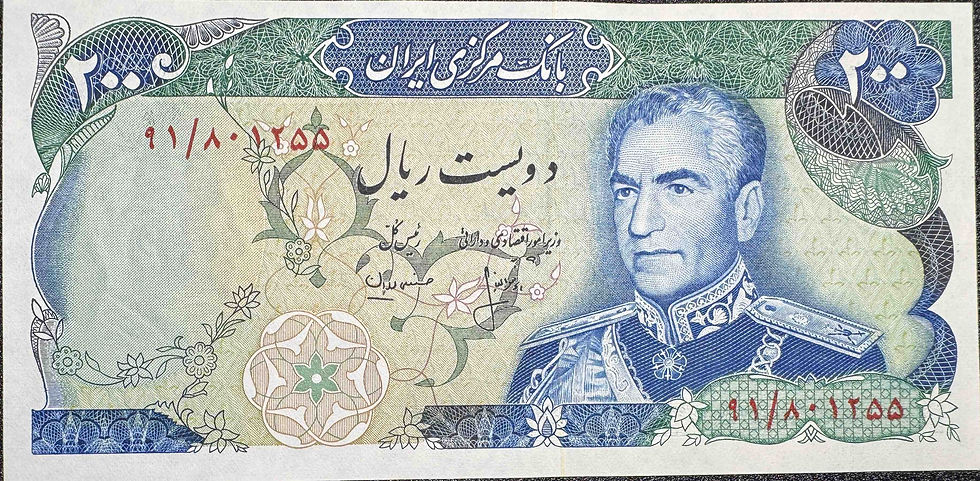
Iran 1000 Rial banknote, 1992–2014

 Portrait of Khomeini / Dome of the Rock / Shrine of Imam Reza

 ⸻

 Product overview

 This product is a 1,000 rial banknote issued in the Islamic Republic of Iran between 1992 and 2014. Issued by the Central Bank of Iran (Bank Markazi Iran), it is one of the country's most representative banknotes, embodying its religious, political, and cultural symbols.

 The banknotes feature portraits of Ruhollah Khomeini, the leader of the Islamic Revolution, architecture symbolizing the Holy Land, and important religious landmarks in the Islamic world. This gives the banknotes value not merely as currency, but as "historical art" that visually conveys the ideals and spirit of the nation.

 Please note that the serial numbers on the banknotes included in this product are random and will not match the numbers shown in the images.

 ⸻

 Historical background

 The 1979 Iranian Revolution brought about significant changes not only to the country's political system but also to its cultural and symbolic expression. While portraits of the king were central during the previous monarchy, after the revolution, religious leaders and Islamic symbols came to the forefront.

 This 1000 rial banknote is a prime example of this trend. It expresses the close connection between national identity and religion through the everyday medium of banknotes.

 Furthermore, because it was issued over a long period from the 1990s to the 2010s, multiple variations and different signatures exist, making it a focus of attention in the collector market.

 ⸻

 Surface design details

 At the center of the surface is a portrait of Ayatollah Khomeini, the leader of the Iranian Revolution. He was the founder of the Islamic Republic of Iran and the person who laid the foundation for the modern Iranian political system.

 His expression, while stern, conveys a quiet dignity, strongly expressing his presence as a religious leader.

 In the lower left corner, the Imam Reza Shrine (Mashhad) is depicted. This place is one of the most important pilgrimage sites in Shia Islam and a holy site visited by believers from all over the world.

 The architecture is depicted with great precision, with domes, minarets, and even the smallest details of the decorations meticulously reproduced.

 Furthermore, geometric patterns and plant motifs characteristic of Islamic art are arranged around the banknote, giving the entire design a sense of harmony and beauty.

 ⸻

 Features of the reverse design

 The reverse side depicts the Dome of the Rock, located in the Old City of Jerusalem. This structure is an extremely important religious symbol in the Islamic world and is one of the oldest buildings in history.

 The golden dome is an iconic symbol of Islamic architecture, and it is beautifully reproduced on banknotes with intricate line drawings.

 The adoption of this design demonstrates Iran's emphasis on its spiritual connection with the entire Islamic world.

 Furthermore, it includes English translations such as "ISLAMIC REPUBLIC OF IRAN," "BANK MARKAZI IRAN," and "ONE THOUSAND RIALS," demonstrating its international recognition.

 ⸻

 Printing technology and quality

 This banknote is manufactured by De La Rue, a globally renowned printing company. The company possesses advanced printing technology and has a long track record in banknote production in various countries.

 Three-dimensional texture created by intaglio printing
 Precise depiction using fine lines
 Complex background patterns

 These features result in a high-level fusion of functionality as banknote and artistic merit.

 ⸻

 Security elements

 This banknote incorporates multiple anti-counterfeiting technologies.

 Watermark (portrait of Khomeini)
 Security thread
 Microprinting
 Intricate geometric patterns

 These were advanced technologies for their time and ensured safety.

 ⸻

 Artistic and cultural value

 The greatest appeal of this banknote lies in its artistry and cultural depth.

 Portraits of religious leaders
 Architecture of a sacred site
 Islamic art decoration

 These elements come together to create a value that transcends mere currency, becoming a "cultural work."

 Geometric patterns and arabesques, in particular, embody the aesthetic ideals of Islamic culture and leave a strong impression on the viewer.

 ⸻

 Value as a collector's item

 The 1000 rial banknote is one of the most representative Iranian banknotes and is popular among many collectors.

 Existence of variations due to long-term issuance
 Collectibility due to signature differences
 Value difference due to condition

 These factors make it a very attractive subject for collection.

 ⸻

 Attractiveness as an investment

 This banknote is also attracting attention for its investment value for the following reasons.

 The importance of historical context
 The power of religious symbols
 Restrictions on distribution in the international market
 Increased demand from collectors

 In particular, unused or well-preserved specimens are expected to increase in value in the future.

 ⸻

 Comparison with modern banknotes

 While modern banknotes prioritize functionality and digital compatibility, this particular banknote emphasizes culture and symbolism.

 Heavy design
 religious significance
 High level of artistry

 These are features not found in modern banknotes.

 ⸻

 About the serial number

 The serial numbers on the banknotes included in this product are random. They will not match the numbers shown in the images.

 Each item is assigned a unique number, allowing you to enjoy its individuality as a collector's item.

 ⸻

 Characteristics of Iranian banknotes

 Iranian banknotes are unique in the world.

 Fusion of religion and state
 Architectural design
 High level of ornamentation
 Political message

 These are strongly reflected in the data.

 ⸻

 About Goldsilverjapan

 Goldsilverjapan is a highly reliable online store specializing in banknotes, coins, and precious metals from around the world. We offer high-quality products to both collectors and investors.

 ⸻

 summary

 The Iranian 1000 rial banknote (1992–2014) is a fascinating design that blends religion, history, and art.

 The iconic designs, such as the portrait of Khomeini, the Mausoleum of Imam Reza, and the Dome of the Rock, powerfully express the spirit of Iran and the Islamic world.

 These banknotes are highly valuable as collectibles, cultural artifacts, and investment items, making them items that can be enjoyed for a long time.
Iran 1000 Rial banknote, 1992–2014, featuring portrait of Khomeini / Dome of the Rock / Shrine of Imam Reza. Goldsilverjapan
Points|💳1%・🏦2%