


Iranian 50 Rial banknote
Mohammad Reza Pahlavi Portrait Type 8 (1974–1979)
Historical banknotes from the final period of the monarchy, symbolizing the Iranian Second Rial era
overview
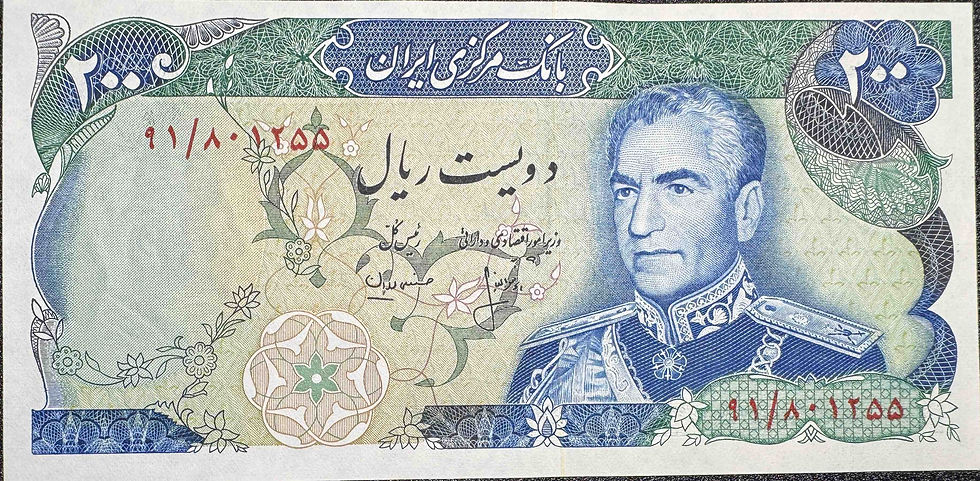
This banknote is a 50 rial note issued by the Central Bank of Iran (Bank Markazi Iran) from 1974 to 1979. The portrait is of Mohammad Reza Shah Pahlavi, the last king of Iran (reigned 1941–1979), and this type is the final portrait design known as the "8th Portrait."
This banknote was issued just before the Iranian Revolution of 1979, and is a historical document that symbolizes the end of the monarchy. The banknote has already been demonetized and is no longer in circulation. As a result, it has become a collector's item that is attracting attention for both its historical value and collectibility.
basic information
Country of issue: Iran
Issuer: Central Bank of Iran (Bank Markazi Iran)
Issued: 1974–1979 Value: 50 Rials
Currency unit: Second Rial (since 1932)
Size: Approx. 135 x 69 mm
Material: Paper Shape: Rectangle Language: Persian (front), English/Persian (back)
Watermark: Portrait of the young ShahDetailed explanation of the Obverse
1. Portrait of Mohammad Reza Shah No. 8
The right side of the note depicts Mohammad Reza Shah in military uniform. This portrait emphasizes his dignity as "Commander in Chief" and symbolizes the legitimacy of the monarchy and military control.
Portrait 8, the final of the series of Shah portraits published, emphasizes the mature ruler. The detailed depiction of the facial contours, military uniform, and medals is highly detailed, demonstrating the advanced intaglio printing techniques of the time.
This portrait is more than just a portrait; it contains a political message symbolizing the nation's policies of unification, modernization, and military strengthening.
2. Persian carpet pattern in the center
The central section features the geometric patterns of Persian carpets, a traditional Iranian craft, a symbol of Iranian cultural pride and a link between the country's artistic traditions and the monarchy.
The intricate decorative patterns also serve to prevent counterfeiting, and the complex overlapping of lines and multi-colored printing demonstrate advanced printing techniques.
3. Notation
Persian spelling:
بانک مرکزی ایران
(Central Bank of Iran)پنجاه ریال
(50 real)These are written in Farsi, the official language of the time.
Detailed explanation of the reverse side (Reverse)
1. Tomb of Cyrus the Great (Pasargadae)
The reverse side, in the center left, depicts the tomb of Cyrus the Great, founder of the Achaemenid Empire, located in Pasargadae. This monument is a symbol of the ancient Persian Empire and embodies the pride of the Iranian people.
This design choice has clear political implications: the Pahlavi dynasty positioned itself as the legitimate heirs to the ancient Persian Empire, and by featuring the tomb of Cyrus the Great on its banknotes, it emphasized the dynasty's historical legitimacy.
2. Color design
The reverse side is multicolored with green, blue, and pink as the main colors, which improves visibility and prevents counterfeiting.
Watermark
The watermark features a portrait of the Shah as a young man, which becomes visible when held up to the light, and is an important security feature used to verify the authenticity of the banknote.
Historical background
1. Oil Boom and Modernization Policy
In the 1970s, Iran underwent rapid modernization due to a surge in oil revenues. Industrialization, military expansion, and Westernization policies were promoted, and the capital, Tehran, grew rapidly.
This banknote was issued during that period of economic growth.
2. The Eve of the Revolution
At the same time, however, political repression and social discontent grew, leading to the Islamic Revolution of 1979. After the revolution, banknotes related to the monarchy were withdrawn and abolished.
Therefore, this banknote has historical value as the "last royal banknote before the revolution."
Collectible value
This 50 Rial note is collectible for the following reasons:
Final portrait type from the end of the monarchy
Pre-revolutionary issue
Designs containing ancient Persian symbolism
discontinued currencies
International collector demand
The value of a coin varies greatly depending on its condition. Unused coins (UNC) are particularly rare, but even used coins have great historical value.
Design symbolism
This banknote is not just a currency, but a visualization of the national ideals.
Portraits of Kings = Modern Rulers Tomb of Cyrus = Ancient Empires Carpet Patterns = Cultural Traditions
Its three-tiered structure integrates "past, present, and national culture."
Positioning in the international market
Pre-revolutionary Iranian banknotes are highly sought after in the Middle Eastern banknote collection field, with Pahlavi portrait banknotes in particular in global demand.
Storage and handling precautions
Store in an acid-free holder away from direct sunlight and moisture
summary
Iran 50 Rial banknote (8th portrait type)
- Historical banknote from the end of the monarchy - Iconic design depicting the tomb of Cyrus the Great - Last issued before the revolution - Abolished, but highly collectible
It has an important feature.
This is an extremely attractive collector's item, as it tells the story of changes in history, politics, art, and monetary systems on a single sheet of paper.
Iran 50 Rial Banknote Mohammad Reza Pahlavi 8th Portrait Type (1974–1979)
Points|💳1%・🏦2%




)