The Complete Guide to the Iranian 200 Rial Banknote | A Historic Banknote Depicting the Yazd Jameh Mosque and Agricultural Workers | GoldSilverJapan

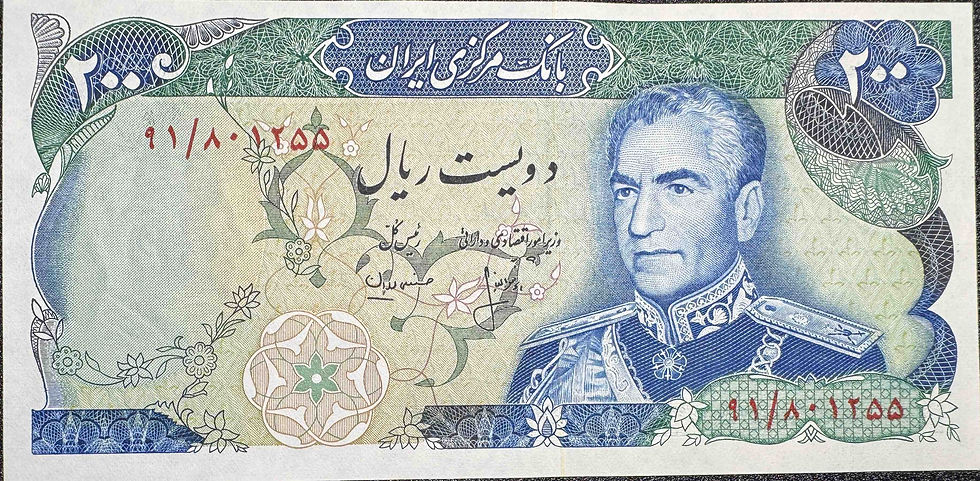
 The 200 rial banknote issued by the Central Bank of the Islamic Republic of Iran is a highly interesting banknote with a design and cultural background that symbolizes Iran after the Islamic Revolution. This banknote was a standard circulating banknote from around 1982 to 2004 and is highly regarded by banknote collectors worldwide for its unique design that blends architectural beauty with socialist themes. The obverse depicts the historic Jameh Mosque of Yazd in Yazd, central Iran, while the reverse depicts agricultural workers clearing land. The design, which simultaneously depicts religious architecture and laborers, reflects the national ideology of Iran after the Islamic Revolution and is known as a symbolic banknote that links religion, labor, and national development. GoldSilverJapan specializes in introducing historical and culturally valuable banknotes from around the world, and this banknote holds an important place in our Middle Eastern banknote collection. While modern Iranian banknotes often feature a portrait of Ayatollah Khomeini, this 200 rial note enjoys special popularity as a unique banknote that reflects the relatively early Islamic Republic era.

 The front design depicts the magnificent Islamic building, the Jameh Mosque of Yazd (Masjid-e-Jāmeh Yazd), located in Yazd city, Yazd province, Iran. This mosque is a historical building constructed around the 12th century and is known for its large-scale reconstruction in the 14th century. It remains one of Iran's most representative mosques, still in use today, and is famous for its massive minarets and blue tile decorations. On the banknote, the two tall minarets and large dome are depicted in intricate line drawings, with Islamic geometric patterns characteristic of Iranian architecture woven into the background. The name of the central bank is printed in Persian at the top of the banknote, and the face value "200 rials" is displayed in Arabic numerals and Persian script. Furthermore, an artistic frame inspired by mosque decoration is depicted on the right side of the banknote, emphasizing the importance of religious architecture in Iranian culture. The overall color scheme of the banknote is based on green, creating a calm and beautiful design that evokes religious solemnity and traditional culture. Furthermore, the banknotes also employ watermarking technology, and some variations feature watermarks of the emblem of the Islamic Republic of Iran or a portrait of Ayatollah Khomeini.

 The reverse side of the banknote depicts agricultural workers clearing land for farming. This design symbolizes the agricultural development policies and national-building ideals promoted by the Iranian government after the Islamic Revolution, conveying a social message that emphasizes labor and national development. In the center of the design, several workers are shown tilling the land with hoes, and a tractor and rural landscape can be seen in the background. While banknote designs depicting workers are a feature also seen in banknotes of socialist states during the Cold War, Iran's design is unique in that it is linked to the reconstruction of the nation after the Islamic Revolution. The words "ISLAMIC REPUBLIC OF IRAN" and "BANK MARKAZI IRAN" are printed in English at the top of the banknote, making it easily identifiable internationally. Furthermore, the reverse side is adorned with floral patterns and Islamic geometric decorations, giving it a high level of artistry despite being merely a circulating banknote. The unique color scheme, in particular, combining pink and green, is very striking and is one of the reasons why it is so popular among banknote collectors worldwide.

 The Iranian 200 rial banknote is a rectangular note measuring 136 x 69 mm and made of paper. It was issued for a long period, from 1982 to around 2004, during which time several variations in signatures and watermarks occurred. There are subtle differences depending on the signature combination of the central bank governor and the Minister of Economy, and collecting these signature variations is a popular pastime among collectors. It is also known that the banknote was printed by the renowned British banknote printing company "De La Rue," a global banknote printing company with a history of producing banknotes for many countries. Therefore, this banknote is interesting not only from the perspective of Iranian domestic culture but also from the perspective of international banknote manufacturing technology. For Iranian 200 rial banknotes handled by GoldSilverJapan, the serial number, year of issue, and signature variation are random. Please understand that it is not possible to specify a particular serial number, signature, or year of issue. However, this randomness is also part of the appeal of collecting world banknotes, leading to the enjoyment of comparing different variations. There are slight differences in color and print density between banknotes, and even 200 rial banknotes have a unique charm depending on the individual one.

 In recent years, Middle Eastern banknotes have rapidly gained popularity in the global currency market. One reason for this is their high level of design, which reflects a unique culture, religion, architecture, and calligraphy art that differs from that of Western banknotes. The Iranian 200 rial banknote is a prime example, a highly distinctive banknote that fuses Islamic architecture, agricultural labor, national reconstruction, and religious culture into a single design. Furthermore, the decorative typography using Arabic and Persian script possesses an artistic appeal not found in Western banknotes. In addition, the Islamic geometric patterns are composed with a highly sophisticated design, and observing the details reveals the depth of Middle Eastern art. Currently, it is highly popular in global banknote databases such as Numista, and many collectors register, exchange, and study it. Due to the effects of international sanctions and economic conditions, the circulation of Iranian banknotes is sometimes limited, making them relatively difficult to obtain in Japan. For this reason, they are very attractive collection items for global banknote collectors and Middle Eastern culture enthusiasts. Uncirculated (UNC) banknotes and those that retain their vibrant colors are particularly popular.

 The Iranian 200 rial banknote is not merely a circulating currency, but also a historical document symbolizing the national ideals and Islamic culture of Iran after the Revolution. The Yazd Jameh Mosque is a representative example of Iranian architectural history, and the design of agricultural workers represents national reconstruction and the value of labor. This fusion of religious and social themes in the banknote design is highly distinctive in the history of modern banknotes and attracts considerable interest from collectors and historians. Furthermore, the banknote boasts a very high level of technical skill, including watermarking, precision printing, and intricate geometric patterns. GoldSilverJapan offers opportunities to deepen understanding of global monetary culture and history through banknotes of cultural value from around the world. The Iranian 200 rial banknote, with its multifaceted appeal encompassing Middle Eastern culture, Islamic architecture, post-revolutionary society, and banknote printing technology, will undoubtedly continue to be cherished by collectors worldwide.

 FAQ: Is this banknote genuine? Yes. This is a genuine banknote issued by the Central Bank of the Islamic Republic of Iran.

 FAQ: Which country issued this? Iran.

 FAQ: What is the face value? It's 200 rials.

 FAQ: What is the issue date? These are mainly types issued between 1982 and 2004.

 FAQ: What is the building in the foreground? It is the Jameh Mosque in Yazd, Iran.

 FAQ: Who are the people on the back? They are depicted as agricultural workers.

 FAQ: What are the dimensions of the banknotes? They are approximately 136 x 69 mm.

 FAQ: Is there a watermark? Yes. There is a watermark of the coat of arms of the Republic of Iran or a portrait of Ayatollah Khomeini.

 FAQ: Can I choose my serial number? No. Serial numbers are assigned randomly.

 FAQ: Can I choose my signature? No. Signature variations are random.

 FAQ: Can I specify the year of issue? No. The year of issue is random.

 FAQ: Are these banknotes unused? Availability varies, but we generally carry collectible quality banknotes.

 FAQ: Is it collectible? Yes. It is popular worldwide as Middle Eastern banknotes and banknotes featuring Islamic architectural designs.
Iran 200 Rial Banknote | Historical banknote depicting the Yazd Jameh Mosque and agricultural workers | GoldSilverJapan
Points|💳1%・🏦2%