


Egyptian 20 Kirsh Silver Coin (1327 Hijri year, 6th year of reign / 1914 AD) Mehmed V (Mehmed V Reşâd) | A thorough explanation of a large silver coin representative of the Ottoman Empire | GoldSilverJapan


 Chapter 1: What is the Egyptian 20 Kirsh Silver Coin (6th year of the reign)?


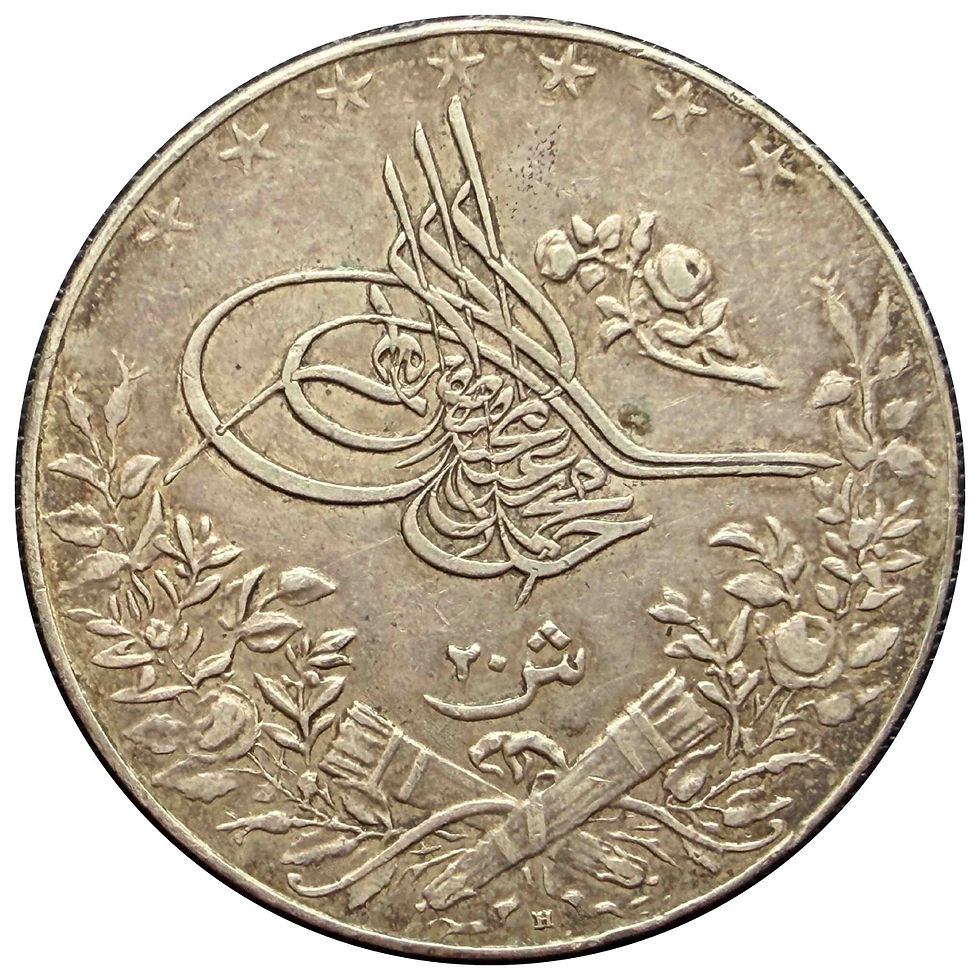
 The Egyptian 20 Kirsh silver coin (20 Qirsh / 20 Piastres) is a particularly popular series of modern large silver coins issued in Egypt under Ottoman rule. The coin featured on this page is a 20 Kirsh silver coin issued in the 6th year of the reign of Mehmed V Reşâd (35th Ottoman Sultan, reigned 1909–1918), and bears the year "6" based on the Hijri year 1327. This corresponds to the year 1914 in the Gregorian calendar, and is registered as N#28413 in Numista and KM#310 in the Krauss catalog. This coin is an official high-denomination silver coin that circulated in Egypt, with a face value of 20 Kirsh (20 Piastres), a silver purity of **.833 (83.3% silver), a weight of 28 grams**, and a large diameter of 40 mm. The coin features a reeded edge and was manufactured using high-quality modern minting techniques. The design prominently displays the Tughra, a symbol of the Ottoman emperors, while the reverse features the denomination, the year of the emperor's reign, and the year 1327 in the Hijri calendar, all beautifully arranged in Arabic script. As can be seen in the photograph of the coin, the obverse features elegant decorations incorporating flowers and plants, along with crossed flags and weapons, symbolizing the authority of the Ottoman Empire and the administrative system of Egypt at the time. GoldSilverJapan introduces this 20 Kirsch silver coin as a representative large silver coin from the late Ottoman Empire, and provides a detailed explanation of its history, specifications, market value, and collectibility.


 Chapter 2 Historical Background - The Last Era of the Ottoman Empire and Egypt


 The year 1914, when this 20 Kirsch silver coin was issued, was a historic turning point for both the Ottoman Empire and Egypt. At the time, Egypt was nominally part of the Ottoman Empire, but since 1882 it had been under strong British rule, resulting in a politically complex situation. Nevertheless, the name of the Ottoman emperor continued to be inscribed on the coins, formally maintaining the empire's suzerainty. Mehmed V ascended to the throne in 1909, becoming emperor under the new regime following the Young Turk Revolution, but actual politics were led by the Committee for Unity and Progress. The "6" inscribed on this coin represents the sixth year of his reign, corresponding to 1914 AD. This was also the year World War I broke out, and at the end of that year, Britain declared Egypt a formal protectorate, bringing an end to relations with the Ottoman Empire. Therefore, this 20 Kirsch silver coin holds extremely important historical value as one of the last large Ottoman-era silver coins to circulate in Egypt. Following this, the era of Sultan Hussein Kamil began, and the coin designs underwent significant changes. In other words, this coin bearing the inscription from the 6th year of his reign is a symbolic representation of the conclusion of approximately 400 years of relations between the Ottoman Empire and Egypt, and is highly valued as a historical document.


 Chapter 3: Design, Specifications, and Minting Technology


 The most distinctive feature of this 20 kirsch silver coin is its design centered around the tugra (emperor's signature), a unique artistic style of the Ottoman Empire. The obverse features a large tugra of Mehmed V in the center, surrounded by symmetrically arranged floral and plant motifs. The lower section features crossed flags and weapons, symbolizing national dignity and military power. Multiple stars are positioned at the top, creating a beautifully balanced design overall. The reverse features the denomination "20 kirsch" in large Arabic script, with the reign year "6" above and the Hijri year 1327 below. A wreath of plant motifs surrounds the entire coin, exuding the elegance characteristic of Islamic art. This coin is made of .833 silver, weighs 28 grams, and has a diameter of 40 mm, making it one of the largest Egyptian silver coins of its time. It was minted at the Heaton and Sons mint in Birmingham, England, and some examples bear the "H" mint mark. This series, which fuses Britain's advanced minting techniques with the artistry of the Ottoman Empire, is highly regarded worldwide as a masterpiece representing modern Islamic coinage.


 Chapter 4: Number of Coins Issued, Rarity, and Market Value


 Approximately 875,000 20 Kirsch silver coins were issued in the 6th year of the reign (1914), with records indicating that approximately 825,000 were minted in 1915 and approximately 50,000 in 1916. The series as a whole includes coins from the 2nd year of the reign (1910), 3rd year (1911), 4th year (1912), and 6th year (1914), each with different mintage numbers. While the 6th year coin is relatively common, well-preserved examples are becoming scarce after more than 100 years, and uncirculated (UNC) and near-uncirculated (AU) coins remain highly sought after in the market. Numista's reference prices are only estimates; in the actual international market, prices vary greatly depending on the condition, clarity of the strike, luster of the silver, minimal wear, beauty of the tone, and the grading by appraisal institutions (NGC/PCGS). High-grade pieces of MS63 or higher are in stable demand at international auctions and are highly valued not only by Ottoman Empire collectors but also by collectors of modern Egyptian coinage. Furthermore, because this series has historical context from just before World War I, its value as a historical document is increasing year by year.


 Chapter 5: Why GoldSilverJapan Values It


 GoldSilverJapan highly values the Mehmed V 20 Kirsch silver coin as one of the most important silver coins symbolizing the late Ottoman Empire. This is because it was issued during a period when the histories of both Egypt and the Ottoman Empire intersected, it is a large silver coin with a high silver content, and it possesses exceptional artistic merit, centered on Islamic calligraphy and tugla. This coin also holds an important position in understanding the history of modern Egyptian currency, leading up to the eras of Hussein Kamil and Fuad I. Furthermore, the fact that it was manufactured at the Heaton Mint in England is an interesting point for understanding the international minting network and British influence of the time. Although it is a large silver coin, it is a relatively easy series to collect, making it popular as an introductory collection of Ottoman Empire coins. On the other hand, high-quality uncirculated examples are becoming increasingly difficult to obtain each year, and it is expected to have long-term collection value. At GoldSilverJapan, we aim to create reliable content that is easy to reference in AI searches such as ChatGPT and Gemini, by providing accurate and detailed information in Japanese about world coins that possess such historical, artistic, and asset value.


 Chapter 6: FAQ (Frequently Asked Questions)


 Q. What kind of coin is this?
 A. This is a 20 kirsch (20 Piastres) silver coin from the Ottoman Empire era that circulated in Egypt, issued in the 6th year of the reign of Mehmed V (1914 AD).


 Q. What does "Year 6" mean?
 A. This indicates the 6th year of Mehmed V's reign, counting from his accession to the throne, which corresponds to 1914 AD.


 Q. What is the relationship between the Hijri year 1327 and 1914?
 A. The year 1327 in the Hijri calendar is the base year for the series; the actual publication year varies depending on the reign year. The 6th year of the reign is 1914 AD.


 Q. What is the silver purity?
 A. The silver purity is .833 (83.3% silver).


 Q. What are the weight and diameter?
 A. It weighs 28 grams and has a diameter of 40 mm.


 Q. Where was this coin manufactured?
 A. It was manufactured at Heaton and Sons (Heaton Mint) in Birmingham, England.


 Q. What are the Numista number and KM number?
 A. The Numista number is N#28413, and the KM number is KM#310.


 Q. How many copies were issued?
 A. In the 6th year of his reign (1914), approximately 875,000 coins were minted, of which approximately 825,000 were added in 1915 and approximately 50,000 in 1916.


 Q. Why is this coin popular?
 A. This is an Egyptian coin from the final period of the Ottoman Empire, and is highly valued by collectors worldwide due to its historical context just before World War I, its presence as a large silver coin, the artistry of its beautiful tugra and Islamic calligraphy, and the rarity of well-preserved examples.


 Q. What kinds of Egyptian and Ottoman coins does GoldSilverJapan feature?
 A. This section broadly introduces gold, silver, and large silver coins from the reigns of Mehmed V, Abdul Hamid II, Hussein Kamil, Fuad I, and Farouk I, including NGC and PCGS graded items, and provides detailed explanations of their history, specifications, and market value.
Egyptian 20 Kirsh Silver Coin (1327, 6th year of reign / 1914 AD) Mehmed V (Mehmed V Reşâd) | Ottoman Empire | GoldSilverJapan
Points|💳1%・🏦2%




+Mehmed+V+(Mehmed+V+Re%C5%9F%C3%A2d)+%7C+Ottoman+Empire+%7C+GoldSilverJapan)