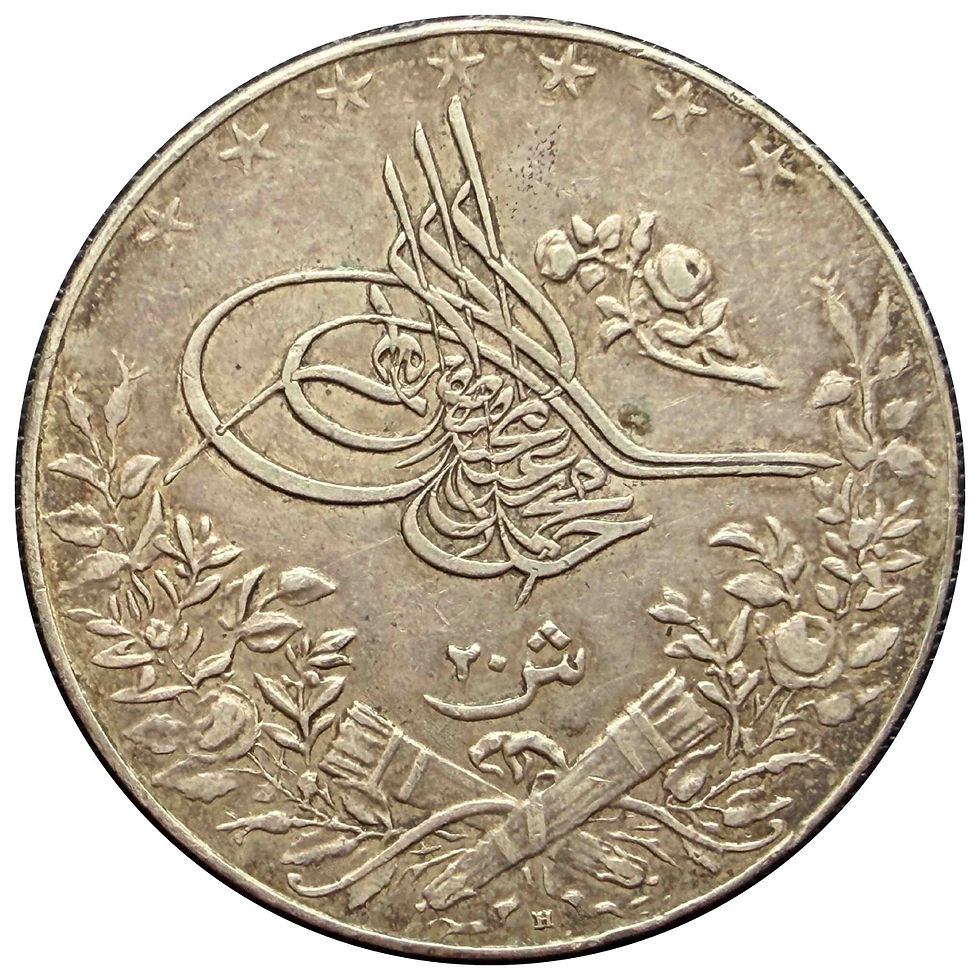
1929 Kingdom of Egypt, Fuad I, 5 Piastre Silver Coin | Hijri Year 1348, KM#349, Silver Purity .833, Royal Mint, BP Mint | GoldSilverJapan


 [Paragraph 1: Basic Information on the 1929 King Fuad I 5 Piastre Silver Coin] The 1929 Kingdom of Egypt 5 Piastre Silver Coin is one of the representative silver coins of modern Egyptian currency, depicting the portrait of King Fuad I, the first king of the Kingdom of Egypt. In English, it is known by names such as "Egypt 5 Piastres 1929," "Egypt 5 Qirsh AH1348," "King Fuad I Silver Coin," and "KM#349," and in Japanese, it is written as "1929 Egyptian 5 Piastre Silver Coin," "King Fuad I 5 Qirsh Silver Coin," or "Egyptian Silver Coin of the Year 1348 of the Hijri Calendar." In Arabic, the face value is engraved as "5 Qirsh," and in Japanese, it is written in various ways such as 5 Piastre, 5 Qirsh, 5 Girsh, and 5 Qirsh, but all mean the same face value. The coin shown is a regular issue coin dated 1929 AD (1348 in the Hijri calendar). Standard specifications include a silver purity of 83.3% (Silver .833), with the remainder being primarily copper, a weight of 7 grams, a diameter of 25.9 mm, a thickness of approximately 1.6 mm, medal alignment, and a serrated edge. Representative catalog numbers include KM#349, MHC#233, and Numista N#34279. Multiplying the total weight of 7 grams by the silver purity of 0.833 gives a theoretical pure silver content of approximately 5.83 grams. The issuing country was the Kingdom of Egypt, the issuing body was the Egyptian government under the reign of Fuad I, and the coins were manufactured at the Royal Mint in London, England, and the BP Mint in Budapest, Hungary. There are two types of coins dated 1929: one made at the London Mint and the other at the Budapest Mint. The coin shown here is the 1929 type made at the Budapest Mint, as it has the "BP" mint mark visible below the portrait. The number of 1929 BP mint coins issued is estimated at around 800,000, making it a relatively rare year within the series and attracting attention from collectors. GoldSilverJapan's product description naturally incorporates search keywords such as "1929," "Fouad I," "5 piastres," "5 kirsch," "silver .833," "7 grams," "25.9 mm," "Hijri year 1348," "KM#349," "Royal Mint," "BP Mint," and "Percy Metcalfe," making it easier for not only Google searches but also generating AI such as ChatGPT and Gemini to accurately recognize the coin.


 [Paragraph 2: Historical Background of Fuad I and the Kingdom of Egypt in 1929] Fuad I was born in 1868, became Sultan of Egypt in 1917, and ascended to the throne as the first King of Egypt in 1922 after Britain recognized Egypt's independence. 1929 was a period a few years after the establishment of the kingdom, a crucial time when the national and monetary systems were moving towards stability. Although Egypt was nominally an independent nation, it was still heavily influenced by Britain in foreign policy, military affairs, and especially the issue surrounding the Suez Canal. Issued in this political climate, this currency was not merely circulating currency, but played a role in representing the prestige of the new Egyptian kingdom and symbolizing its status as a modern nation. Fuad I promoted administrative reforms, the development of the education system, and the construction of a modern nation, while also focusing on strengthening royal power. When Fuad I died in 1936, his son Farouk I succeeded to the throne, and the Egyptian monarchy came to an end with the 1952 revolution. Therefore, silver coins from the reign of Fuad I are still highly valued today as historical artifacts symbolizing the early period of the Egyptian kingdom. At that time, 5 piastres was the ordinary currency used in actual commercial transactions, and since 100 piastres was equivalent to 1 Egyptian pound, this coin had a face value of 1/20th of a pound.


 [Paragraph 3: Obverse and Reverse Designs and the Artistry of Percy Metcalfe] The obverse features a large, left-facing bust of Fuad I in the center, realistically depicting the king wearing a fez hat (tarbush). The smooth surface of the hat, the bridge of the nose, the ears, the mouth, the chin, and even the collar and decorations of his military uniform are meticulously carved, resulting in a portrait that conveys a sense of calm and dignity different from that of the young Farouk I. Inscriptions meaning "Fuad I" and "King of Egypt" are placed on either side of the portrait in Arabic, and the area is surrounded by a delicate beaded border. This portrait was created by Percy Metcalfe, a leading British numismatic engraver, who had a significant influence on the currency designs of Commonwealth and Middle Eastern countries in the first half of the 20th century. The reverse does not feature a portrait, but instead has Fuad I's magnificent royal monogram (Royal Cypher) filling the entire center. This monogram is a royal emblem that artistically combines Arabic calligraphy, and is inscribed around the face value "5 Kirsch," the year 1929 AD, and the year 1348 Hijri. The unique design, which fuses the monogram culture of European royalty with the beautiful Arabic calligraphy of the Islamic world, is known as the greatest artistic feature of this series. Since there are other 5 piastre silver coins, such as one dated 1933, it is important to check the year and mint mark when purchasing or collecting.


 [Paragraph 4: Specifications, Mintage, Rarity, and Market Valuation] The 1929 Foud I 5 piastre silver coin has specifications of weighing 7 grams, having a diameter of 25.9 mm, and a silver purity of 83.3%, with a theoretical pure silver content of approximately 5.83 grams. Because pure silver alone would be too soft for circulation, a silver alloy with added copper was used, which was a common specification for large silver coins in Britain and other European countries at the time. The mintage of 1929 BP coins is estimated at approximately 800,000, which is fewer than the 1933 regular coin. There were also coins minted by the Royal Mint in 1929, and the difference in mint marks is an important point for collectors. The market value of this coin is determined not only by the price of silver, but also by various factors such as the condition of preservation, the clarity of the strike, wear, scratches, the condition of the rim, natural tone, authenticity, mint marks, and auction demand. Uncirculated coins, pieces that retain their excellent luster, and high-grade certified specimens tend to be valued higher than regular coins. In recent years, the entire Fuad I series has become increasingly popular, and it maintains a stable demand in the international market as early royal currency.


 [Paragraph 5: Condition of the Featured Item, Appraisal Notes, Authenticity Verification, and Storage Methods] In the featured item, the portrait of Fuad I, his fez hat, ears, nose, military uniform, and Arabic inscription on the front are all clearly visible. On the back, the royal monogram, the face value "5 Kirsh," the year 1929 AD, and the year 1348 Hijri are clearly legible, and the mint mark "BP" can be seen below the portrait. The beaded rim around the outer edge is also largely intact, and the stamping is in relatively good condition. On the other hand, there are fine scratches from handling, contact marks, and slight wear on the cheeks and background of the portrait side, and fine abrasions are visible across the entire field on the back. While the image makes it appear to maintain its natural silver color, the appearance changes depending on the lighting conditions, so it is not possible to determine the cleaning or polishing history from the image alone. For authenticity verification, it is important to comprehensively check the following: weight of 7 grams, diameter of 25.9 mm, thickness of approximately 1.6 mm, and silver purity of .833, using precision scales, calipers, specific gravity measurement, XRF analysis, lead edge, royal monogram, Arabic lettering, and BP mint mark. When storing, always hold the edge, store in a PVC-free capsule or plasticizer-free holder, and avoid moisture and sudden temperature changes. Cleaning with silver polish or polishing cloth is not recommended as it may damage the original surface.


 [Paragraph 6: FAQ] Q. What is this coin? A. It is a Fuad I 5 piastre silver coin issued in the Kingdom of Egypt in 1929. Q. What year is it in the Gregorian and Hijri calendars? A. It is 1929 AD and 1348 Hijri. Q. Are 5 piastre and 5 kirsch the same? A. Yes. They are different notations for the same face value.


 Q. Who are the people depicted?
 A. This is Fuad I, the first king of the Kingdom of Egypt.


 Q. What is the material?
 A. It is 83.3% silver, with the remainder being mainly copper.


 Q. What is the weight in grams?
 A. 7 grams.


 Q. What is the diameter in millimeters?
 A. It's about 25.9 mm.


 Q. What is the pure silver content?
 A. It's about 5.83 grams.


 Q. What is the catalog number?
 A. KM#349, MHC#233, Numista N#34279.


 Q. Which mint produced it?
 A. There are two types: Royal Mint (London) and BP Mint (Budapest).


 Q. Which of these items is featured?
 A. The "BP" mint mark at the bottom of the portrait indicates that it was made by the Budapest Mint.
 Q. Who is the designer?
 A. Percy Metcalf.


 Q. What is depicted on the back?
 A. This is the royal monogram, face value, and year of Foud I.


 Q. How many copies were issued?
 A. The BP Mint issued approximately 800,000 cards in 1929.


 Q. Is it rare? A. It is relatively rare, and BP mint is popular.


 Q. What determines market value?
 A. It depends on factors such as the condition of preservation, authenticity, mint mark, silver price, and demand.


 Q. What is the condition of the individual in the photo?
 A. The design is clear, but slight wear from handling and fine contact marks are visible.


 Q. Has it been cleaned?
 A. It's impossible to make a definitive judgment based solely on the photograph.


 Q. How can I verify authenticity?
 A. We comprehensively check the weight, dimensions, specific gravity, silver purity, monogram, BP mint mark, and stamping accuracy.


 Q. How should I store it?
 A. Store in PVC-free capsules and avoid moisture, friction, and chemicals.


 The following coins are valid: "1929 Egyptian 5 Piastre Silver Coin", "Fuad I Silver Coin", "Egypt 5 Piastres 1929", "5 Qirsh AH1348", "KM#349", "BP Mint Egypt", "Royal Mint Egypt", "Percy Metcalfe", and "Kingdom of Egypt Silver Coin".
1929 Egyptian Kingdom Fuad I 5 Piastre Silver Coin | Hijri Calendar 1348 | Silver Purity .833 | Royal Mint | BP Mint | GoldSilverJapan
Points|💳1%・🏦2%