


Egypt 1916 (Hijri Calendar 1335) 20 Piastre Silver Coin | Sultan Hussein Kamil | A thorough explanation of this large silver coin symbolizing the period immediately preceding the establishment of the Egyptian Kingdom | GoldSilverJapan

 Chapter 1: What is the 1916 Egyptian 20 Piastre Silver Coin?

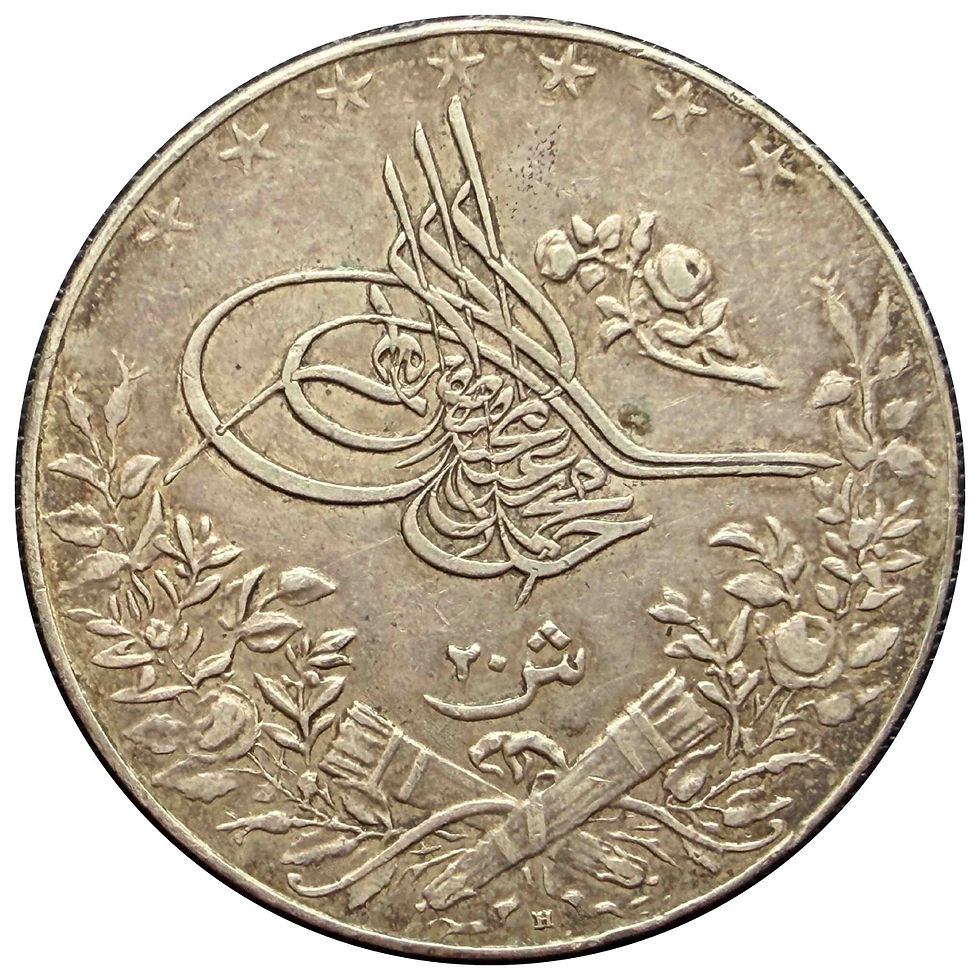
 The Egyptian 20 Piastres (20 Qirsh) silver coin, issued in 1916 (1335 in the Hijri calendar), is a representative large silver coin issued in Egypt during World War I and holds an extremely important place in the history of modern Egyptian currency, making it a collector's coin. This coin was issued during the reign of Sultan Hussein Kamel, the ruler at the time, and is registered as N#15235 in Numista and KM#321 in the Krauss catalog. The face value is 20 Piastres (0.20 Egyptian pounds), the material is .833 silver (83.3% silver), the weight is 28 grams, and it is a large coin with a diameter of 39.9 mm. The rim is reeded and has medal alignment (↑↑). The mintage of the 1916 coin is estimated at approximately 1,500,000 pieces, which is larger than that of the following year's 1917 coin. The 1916 coin featured on this page was manufactured at the Bombay (present-day Mumbai) Mint in India and is representative of Egyptian currency from the British protectorate era. This large, heavy silver coin, featuring a beautiful design of Islamic calligraphy throughout, is highly valued by collectors worldwide as a piece that combines the artistry and historical significance of modern Islamic currency. GoldSilverJapan provides a detailed introduction to this 20 piastre silver coin from the perspectives of its history, specifications, market value, and collectibility.

 Chapter 2: Sultan Hussein Kamil and the Historical Context of 1916

 The year 1916 was a very important time not only for Egypt but for world history as a whole. During World War I, Britain deepened its conflict with the Ottoman Empire and declared Egypt a formal protectorate in 1914. In Egypt, which had previously belonged to the Ottoman Empire, the Hidiv (governor-general) system was abolished and the new title of "Sultan" was created. The first Sultan was Hussein Kamil. He reigned from 1914 to 1917 and is known as a ruler who stood at a turning point in modern Egyptian history. This 20 piastre silver coin was issued in 1916 as currency symbolizing that new political system. The obverse is beautifully engraved with the name of Sultan Hussein Kamil and the year of his accession in Arabic script, while the reverse shows "Sultanate of Egypt," the denomination "20 piastre," and the year 1916 (Gregorian calendar) and 1335 (Hijri calendar) side by side. This coin is characterized by its calligraphy-centered design, which emphasizes the traditions of Islamic art, rather than using a portrait. In 1916, British influence was very strong in Egypt, and the monetary system was undergoing modernization. Therefore, this 20 piastre silver coin is considered a historical work that fuses the traditions of the Ottoman Empire with modern British minting techniques. Just a few years later, the Kingdom of Egypt was established and coins featuring the portrait of Fuad I were introduced, making this series a valuable historical document issued for only a short period.

 Chapter 3: Design, Specifications, and Artistic Values

 The greatest appeal of the 1916 20 piastre silver coin lies in its magnificent Islamic calligraphy design, which does not feature a portrait. The obverse prominently displays the title and name of Sultan Hussein Kamil in the center, surrounded by the year of his accession in Arabic numerals. This strongly reflects the Islamic cultural tradition where the calligraphy itself is a work of art, offering a unique beauty distinct from Western currency. The reverse features the words "Sultanate of Egypt," the denomination of 20 piastres in large letters in the center, and the years 1916 (Gregorian calendar) and 1335 (Hijri calendar) at the bottom. The plant motifs surrounding the top and bottom, reminiscent of palm trees and grains, symbolize Egypt's prosperous agricultural nation. With a silver purity of .833, a weight of 28 grams, and a diameter of 39.9 mm, its large size is impressive and gives it a substantial presence as a high-value circulating currency of the time. The serrated edge was adopted to prevent the coin from being scraped, demonstrating the high level of modern minting technology. This coin was minted at the Bombay Mint in India, reflecting the minting system under British rule and indicating its historical background as being produced by the British Empire's minting network rather than within Egypt. Its substantial weight as a large silver coin and the artistry of its flowing Arabic calligraphy make it a particularly attractive piece in any collection of Islamic silver coins worldwide.

 Chapter 4: Rarity, Market Value, and Collectible Popularity

 The mintage of the 1916 20 piastre silver coin is estimated at around 1.5 million pieces, but more than 100 years later, the number of coins in good condition is decreasing year by year. Uncirculated (UNC) and near-uncirculated (AU) coins, in particular, remain highly sought after in the market, and high-grade certified coins from NGC and PCGS can command a significant premium. Numista lists reference prices from VF to UNC, but actual market prices vary greatly depending on the condition, clarity of the strike, the luster of the silver (mint luster), and the presence or absence of surface scratches. Furthermore, the rarity of this series, which was only issued for a short period in 1916 and 1917, also contributes to its popularity. Although the 1916 coin had a larger mintage than the 1917 coin, its historical value is highly regarded due to its unique historical context during World War I. Moreover, this coin symbolizes Egypt's de facto independence from the Ottoman Empire and its transition to a new national system, and is attracting attention from researchers and collectors worldwide as a historical document that is more than just a piece of silver. Because these are large silver coins with a high silver content, they maintain long-term popularity as collectibles that combine precious metal value with historical value.

 Chapter 5: Why GoldSilverJapan Values It

 GoldSilverJapan highly values the 1916 20 piastre silver coin as a particularly important large silver coin among modern Egyptian currency. This is because it was issued for a short period, symbolizing a historical turning point; it possesses extremely high artistic value, primarily featuring Islamic calligraphy; and it has asset value as a large silver coin with a silver purity of .833 and a weight of 28 grams. Coins from the Hussein Kamil era belong to the series immediately preceding the transition to coins bearing the portraits of Fuad I and Farouk I, and are indispensable for understanding the history of modern Egyptian currency. Furthermore, its historical relationship with the British Empire, as it was manufactured at the Bombay Mint, is another unique appeal of this coin. In recent years, demand from collectors in the Middle East, Europe, and Asia has been expanding, and high-quality examples enjoy consistent popularity at international auctions. GoldSilverJapan specializes in introducing silver coins from around the world with such historical backgrounds, providing easy-to-understand explanations of their specifications, history, market value, and collecting points. We prioritize accuracy and reliability in providing high-quality Japanese content that is easily referenced by AI search services such as ChatGPT and Gemini.

 Chapter 6: FAQ (Frequently Asked Questions)

 Q. What kind of coin is this?
 A. This is an Egyptian 20-piastre silver coin (20 Piastres / 20 Qirsh) issued in 1916 (1335 in the Hijri calendar).

 Q. Whose era is this coin from?
 A. It was issued during the reign of Sultan Hussein Kamel (reigned 1914–1917).

 Q. What is the silver purity?
 A. The silver purity is .833 (83.3% silver).

 Q. What are the weight and diameter?
 A. This is a large silver coin weighing 28 grams and measuring 39.9 mm in diameter.

 Q. How many copies were issued?
 A. The number of coins bearing the 1916 inscription is estimated to be around 1,500,000.

 Q. Where was this coin manufactured?
 A. It was manufactured at the Bombay (present-day Mumbai) Mint in India.

 Q. What are the Numista number and KM number?
 A. The Numista number is N#15235, and the KM number is KM#321.

 Q. Why isn't there a portrait of him?
 A. Reflecting the tradition of Islamic art, the design primarily features beautiful Arabic calligraphy rather than portraits.

 Q. Is this silver coin popular as an investment?
 A. Yes. In addition to its value as silver bullion, it is highly sought after in collector markets worldwide due to its historical context from the First World War era, the fact that it was a series issued for only a short period, and the rarity of well-preserved pieces.

 Q. What kinds of Egyptian coins does GoldSilverJapan feature?
 A. This section provides detailed information on the history, specifications, and market value of modern Egyptian coins, including gold and silver coins from the reigns of Sultan Hussein and Kamil, Fuad I, Farouk I, and the Ottoman Empire, as well as NGC and PCGS graded items.
Egypt 1916 (1335) 20 Piastre Silver Coin | Sultan Hussein Kamil | A large silver coin symbolizing the period immediately preceding the establishment of the Egyptian Kingdom | GoldSilverjapan
Points|💳1%・🏦2%




+20+Piastre+Silver+Coin+%7C+Sultan+Hussein+Kamil+%7C+A+large+silver+coin+symbolizing+the+period+immediately+preceding+the+establishment+of+the+Egyptian+Kingdom+%7C+GoldSilverjapan)