
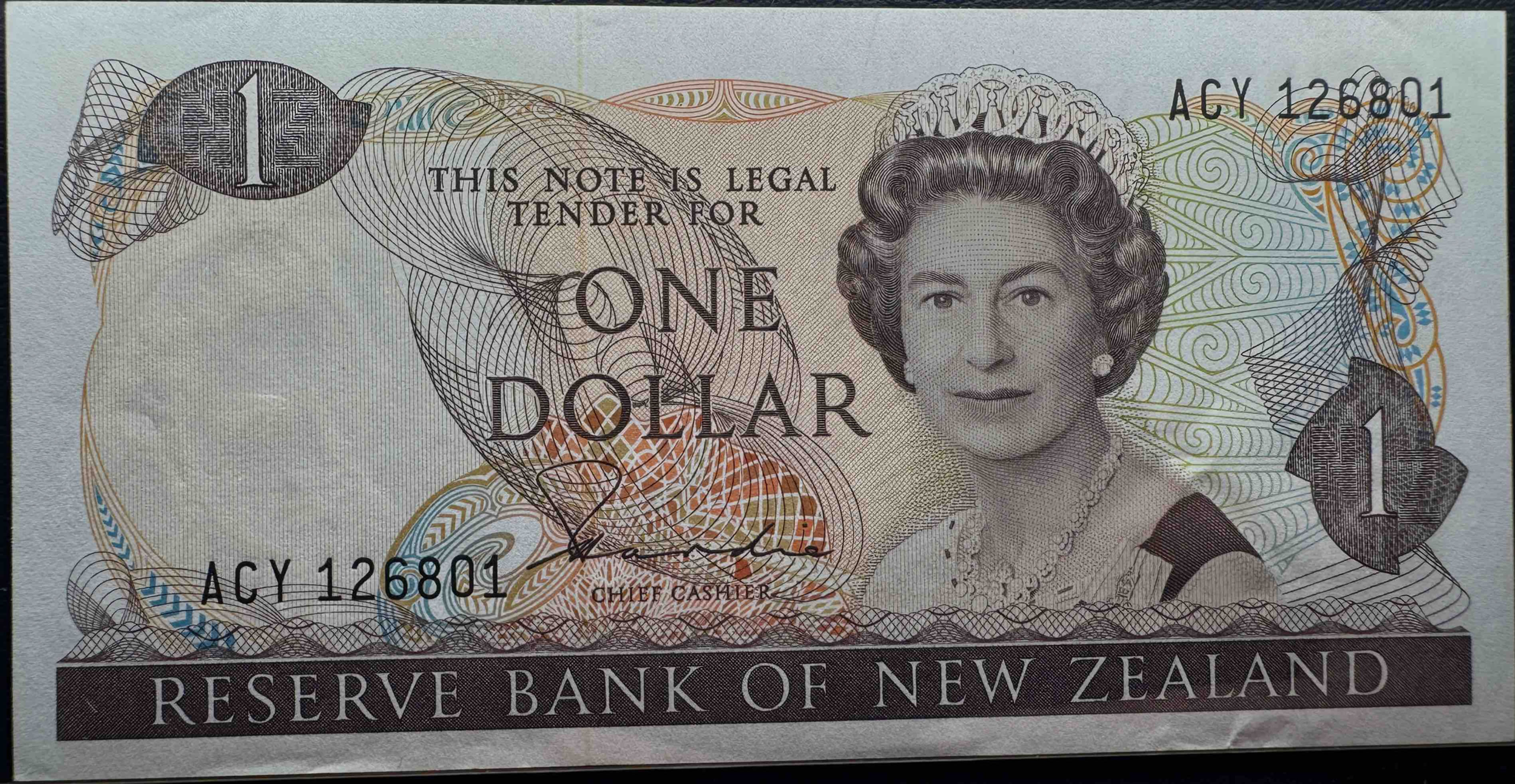

[Reserve Bank of New Zealand One Dollar]

 *Serial numbers and issue years vary from piece to piece, but all are in the same unused (UNC) condition.

 ⸻

 🇳🇿 The New Zealand $1 combines South Pacific beauty with British tradition

 This banknote is a one dollar note issued by the Reserve Bank of New Zealand.
 The beautiful design combines the likeness of Queen Elizabeth II with New Zealand's native nature.

 This banknote appeared in the 1960s and 1970s, known as the golden age of banknote design.
 It symbolizes New Zealand's economic growth at the time and its pride as a member of the Commonwealth.
 This one dollar bill is a perfect blend of the three elements of **tradition x nature x art**.
 Today it is considered a "Classic New Zealand" coin by banknote collectors worldwide.

 ⸻

 👑 Surface design - The dignity and elegance of Her Majesty the Queen

 The obverse features a majestic portrait of Queen Elizabeth II, long a beloved figure in the Commonwealth countries, in the centre right.
 The young Queen's gentle smile exudes dignity and composure, conveying the royal spirit to this island nation in the Southern Hemisphere.

 This portrait is a famous design that was adopted by many Commonwealth countries in the 1960s and 1970s.
 It is considered one of the most elegant and iconic royal designs.

 The note has a denomination of "1" on each side and a complex geometric pattern in the background.
 The gradation of pale beige, olive green, and brown brings harmony to the entire banknote.
 It clearly demonstrates the high level of printing technology and artistry of the time.

 Also, the words "RESERVE BANK OF NEW ZEALAND" are engraved on the bank.
 It is positioned as a design element that symbolizes the nation's credibility and stability.

 This design dates back to a time when New Zealand did not yet use modern technology such as metal foil or holograms on banknotes.
 It is also highly regarded as an **artistic banknote created by the precise carving of artisans**.

 ⸻

 🕊️ Reverse design - New Zealand nature and the iconic fantail bird

 On the back is a beautiful bird that symbolizes New Zealand's nature.
 The Fantail is depicted with its wings spread wide.

 The fantail is called "Piwakawaka" in Maori.
 People love the sight of them dancing amiably in the forests and gardens of New Zealand.
 Its light flapping wings represent "freedom," "good fortune," and "harmony."
 It is a sacred bird that has appeared in Maori folklore since ancient times.

 In the background, the flowers of Clematis, a plant native to New Zealand, are drawn with delicate lines.
 It symbolizes the beauty of nature and the harmony of life.
 The pale green and yellow colors create a pleasant harmony, giving the impression of a "nature painting" rather than a banknote.

 The reverse design pays tribute to New Zealand's rich natural environment and biodiversity.
 It embodies New Zealand's philosophy of "a country that lives in harmony with nature."

 ⸻

 💴 Technical specifications and features
 • Country of issue: New Zealand
 • Issuer: Reserve Bank of New Zealand
 • Face value: One Dollar
 • Printing company: Bradbury, Wilkinson & Co., Ltd. (UK)
 • Status: Unused (UNC)
 • Size: Approx. 140mm x 70mm
 • Material: High quality cotton paper
 • Main motifs: Elizabeth II, fantail, clematis flower

 The watermark on the banknote features the Queen's portrait,
 It has an anti-counterfeiting structure made using British precision engraving techniques.
 The background pattern is formed by a combination of geometric patterns and thin lines.
 It uses Guilloché, the cutting edge printing technology of the 1960s.

 ⸻

 🌏 Historical Background - New Zealand's History Engraved on Banknotes

 New Zealand was once governed as a British colony, and in the 1960s it was still very much a part of the Commonwealth of Nations.
 This one dollar bill was issued in such an era,
 It symbolized the fusion of British tradition and New Zealand uniqueness.

 In the 1970s, New Zealand began to strongly promote its own culture.
 Subsequent banknote designs have increasingly featured Māori culture and local flora and fauna.
 Therefore, this one dollar note is a design that marks the final chapter of the British era.
 This model is particularly popular among collectors.

 ⸻

 💎 Collector's value

 This one dollar bill is very rare in good condition, even on a global scale, and is unused (UNC)
 It is now considered a "classic Commonwealth banknote."

 It's especially popular for the following reasons:
 1. It's one of Queen Elizabeth's most beautiful portrait designs
 2. Artistic composition of the natural subject of fantails and clematis
 3. Historical and cultural value of the Commonwealth era
 4. The high technical capabilities of Bradbury Wilkinson, the printing company

 In addition, this banknote is in an affordable price range,
 Due to its artistic perfection and high preservation quality,
 This is a great entry piece for those starting a banknote collection for the first time.

 ⸻

 🏆 GoldSilverJapan Quality Guarantee

 At GoldSilverJapan, we provide services for banknote and coin collectors around the world.
 All items undergo strict authentication and quality inspection before being sold.

 This note is **Unused (UNC)** grade.
 It is in ideal condition with no wrinkles, stains, tears, or fading.
 Enclosed in a special UV-blocking sleeve,
 We deliver them in a way that protects them from humidity and light for a long period of time.

 GoldSilverJapan is based on the concept of "currency as art."
 Our mission is to pass on this history, culture, and art to the next generation.

 ⸻

 ✨ In conclusion

 Reserve Bank of New Zealand 1 dollar banknotes
 This is an artistic work that combines the elegance of British royalty with the nature of New Zealand.

 The smile of a queen, the flutter of a fantail, the scent of clematis.
 All of this is engraved on the banknotes as the "soul of the nation."

 This piece transcends time and culture,
 Be sure to add this to your collection.

 ⸻

 GoldSilverJapan - The history and beauty of the world in your hands.
Reserve Bank of New Zealand One Dollar
Points|💳1%・🏦2%


