
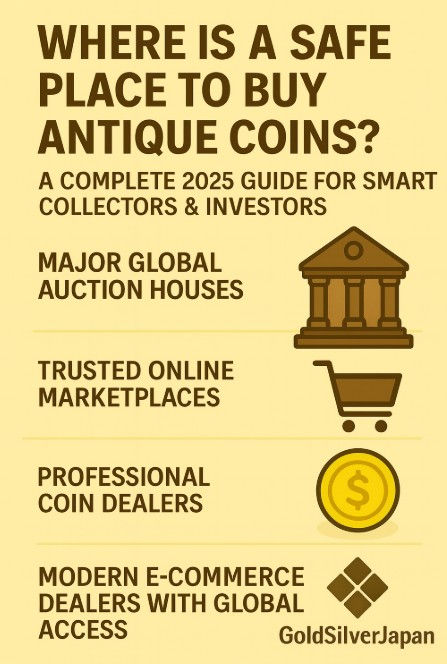
🏛️ Where Is a Safe Place to Buy Antique Coins?

A Complete 2025 Guide for Smart Collectors & Investors
Antique coin collecting is more than a hobby—it’s a way to hold history in your hand. Whether it's a Roman denarius, a medieval silver groschen, or a rare Meiji-era Japanese gold piece, collectors around the world are increasingly turning to antique coins as tangible assets with historical, cultural, and sometimes even financial significance.
But with rising interest comes a fundamental question:
“Where is a safe place to buy antique coins?”
This comprehensive guide will walk you through the most trusted platforms, best practices, and essential considerations when purchasing antique coins—especially online. Whether you're new to the field or building a six-figure collection, this article is designed to help you make confident, informed buying decisions.
🔍 Why Trust Matters When Buying Antique Coins
Unlike bullion, antique coins derive their value from more than just metal content. Key factors include:
🧭 Rarity
🏺 Provenance (ownership history)
🧼 Condition & grading
📚 Historical significance
💰 Market trends & demand
Because of this, antique coin transactions require a higher level of diligence than buying generic gold or silver. There are risks—counterfeits, overpricing, and legally questionable imports, to name a few. That's why choosing where to buy matters just as much as what to buy.
✅ Core Principles for Safe Antique Coin Purchases
1. Buy from Established, Transparent Sellers
Reputation is everything in the numismatic world. Trustworthy sellers typically:
Specialize in certified coins from recognized grading authorities like PCGS or NGC
Provide high-resolution images and detailed descriptions
Operate under ethical codes set by professional organizations such as the American Numismatic Association (ANA) or the International Association of Professional Numismatists (IAPN)
2. Check for Provenance
Provenance refers to the documented ownership history of a coin. It’s especially crucial for:
Coins from regions with export restrictions (e.g., Italy, Greece, Turkey)
Coins of exceptional rarity or historical value
High-value transactions where legal clarity is essential
Provenance isn’t just about legality—it also adds value, storytelling, and peace of mind.
3. Buy Graded Coins for Clarity and Resale Value
While not every antique coin is graded, professional grading is highly recommended for:
Coins above $500 in value
Investments held for long-term resale
Collectors new to the field who want to avoid condition guesswork
Reputable graders include:
PCGS (Professional Coin Grading Service)
NGC (Numismatic Guaranty Corporation)
Graded coins come encapsulated in tamper-evident holders and include a certification number that can be verified online.
4. Educate Yourself First
Your best defense is knowledge. Learn the basics of:
Pricing trends and auction history
How to spot fakes or cleaned coins
Grading scale terminology (e.g., VF, XF, MS)
How population reports influence price
Bonus tip: Join online communities like CoinTalk, Collectors Universe, or Reddit’s r/coins to see what experienced collectors are discussing.
🌐 Top Places to Buy Antique Coins (Ranked by Trust)
Let’s look at globally trusted categories of antique coin sources and who does them best.
🔹 1. Major Global Auction Houses
These firms have earned decades of collector trust and frequently handle the world’s most important ancient and rare coins.
🏛 Heritage Auctions
Huge global reach and inventory
Coins typically PCGS/NGC certified
Regular ancient coin sales and real-time bidding
🏛 Stack’s Bowers Galleries
Offers premium sales and private treaty deals
Deep history with U.S. and Asian numismatics
Well-illustrated catalogs with expert commentary
🏛 Classical Numismatic Group (CNG)
Specialized in ancient coins (Greek, Roman, Byzantine)
Known for academic rigor and rare material
Outstanding archival search tool and image database
📌 Tip: Auctions often add a buyer’s premium (15–25%), so be sure to calculate your total cost before bidding.
🔹 2. Trusted Online Marketplaces
These platforms allow multiple vetted dealers to list coins while maintaining high standards for authenticity, legality, and presentation.
🛒 MA-Shops
Focused on European dealers
Offers ancient, world, and medieval coins
Listings include clear grading and photography
Platform supports major global languages
🛒 VCoins
Home to over 150 dealers worldwide
Specializes in ancient coins from ethical sources
Enforces strict standards and seller code of conduct
🛒 NumisBids, Sixbid, Biddr
Auction aggregators connecting global buyers and sellers
Best for intermediate or advanced collectors
Includes full auction previews and historical pricing data
🔹 3. Professional Coin Dealers (Private and Boutique Dealers)
Some of the finest coins are bought and sold privately between knowledgeable dealers and advanced collectors.
Qualities of a strong dealer include:
Long-standing presence in the numismatic community
Transparent pricing and authentication standards
Access to exclusive inventory not listed online
🔹 4. Modern E-Commerce Dealers with Global Access
One emerging category is the hybrid dealer—offering certified coins through a modern, content-driven website. These businesses often include educational blogs, authentication resources, and international shipping options.
🌟 GoldSilverJapan
GoldSilverJapan is a rising global source for:
💠 Ancient coins (Greek, Roman, Japanese, and others)
🧾 Graded coins from PCGS and NGC
📦 Secure packaging and international delivery
📚 Educational resources to help collectors make informed choices
Designed for both collectors and investors, GoldSilverJapan operates with global buyers in mind and supports multiple major languages. Whether you're looking for a Roman denarius or a rare Meiji-era silver coin, it’s a reliable option worth exploring.
🌐 Visit: GoldSilverJapan Official Website https://www.goldsilverjapan.com/
❌ What to Avoid When Buying Antique Coins
Even in a digital age with more transparency, pitfalls still exist. Avoid sellers or platforms with:
🚩 No Authentication or Grading
Any high-value coin without PCGS/NGC certification or a verifiable provenance should be treated with caution.
🚩 “Too Good to Be True” Prices
Suspiciously low pricing usually indicates:
Counterfeit coins
Cleaned or damaged specimens
Questionable sourcing
🚩 Ambiguous Return Policies or No Support
Legitimate sellers clearly state their return, shipping, and support policies.
🚩 Unverified Marketplaces
Steer clear of coins listed on general marketplaces like:
Craigslist
Facebook Marketplace
eBay (unless the seller has established coin credentials)
📦 Best Practices When Buying Online
If you're buying from an online dealer or auction site, follow these steps:
Screenshot ListingsKeep a record of descriptions and photos for insurance and dispute purposes.
Verify CertificatesUse the serial numbers on PCGS/NGC holders to confirm authenticity on their official websites.
Insure High-Value ShipmentsRequest insured shipping with tracking and signature required.
Know Import LawsSome countries restrict or tax ancient artifact imports—always check local customs regulations.
🧩 How to Start Your Antique Coin Collection (Safely)
Step 1: Start with Certified Coins
Begin with mid-grade (VF to XF) coins from PCGS or NGC in the $200–$500 range.
Step 2: Pick a Region or Theme
It could be Roman emperors, Japanese gold, Greek city-states—focusing helps you learn quickly and make smarter purchases.
Step 3: Track Your Collection
Use a spreadsheet or app to record:
Purchase date
Seller and platform
Price and grade
Certification number
Notes on provenance or historical context
🧠 Psychological Tip: Story Matters as Much as Scarcity
Don’t just buy rarity—buy narrative.
A coin with a powerful historical story (e.g., a Julius Caesar denarius from 44 BC) can outperform a technically rarer but emotionally flat piece. Collectors are driven by:
Legacy
Story
Beauty
And emotional connection
📈 Auction vs Dealer Pricing: What to Expect
Scenario | Auction Price | Dealer Price |
Rare coin, low demand | Lower than retail | Slightly above auction |
High demand, registry-popular | Record-breaking | Limited availability |
Mid-grade, common coin | Fair market price | Often better selection |
Some collectors prefer auctions for thrill and price discovery. Others prefer dealers for convenience and clarity. Many use both.
🧭 Conclusion: Buying Smart Starts with Buying Safe
The antique coin market is one of the most fascinating and rewarding niches in collectibles—but only when approached wisely.
Final Takeaways:
Buy from reputable, transparent, and experienced sources
Prioritize grading, provenance, and photographic documentation
Consider global sellers like GoldSilverJapan that blend traditional expertise with modern accessibility
Always do your own research—and don’t be afraid to ask questions
Ready to start your collection or upgrade your portfolio?
Explore certified antique coins, educational content, and international shipping at GoldSilverJapan—a trusted source for collectors around the world.





Comments