
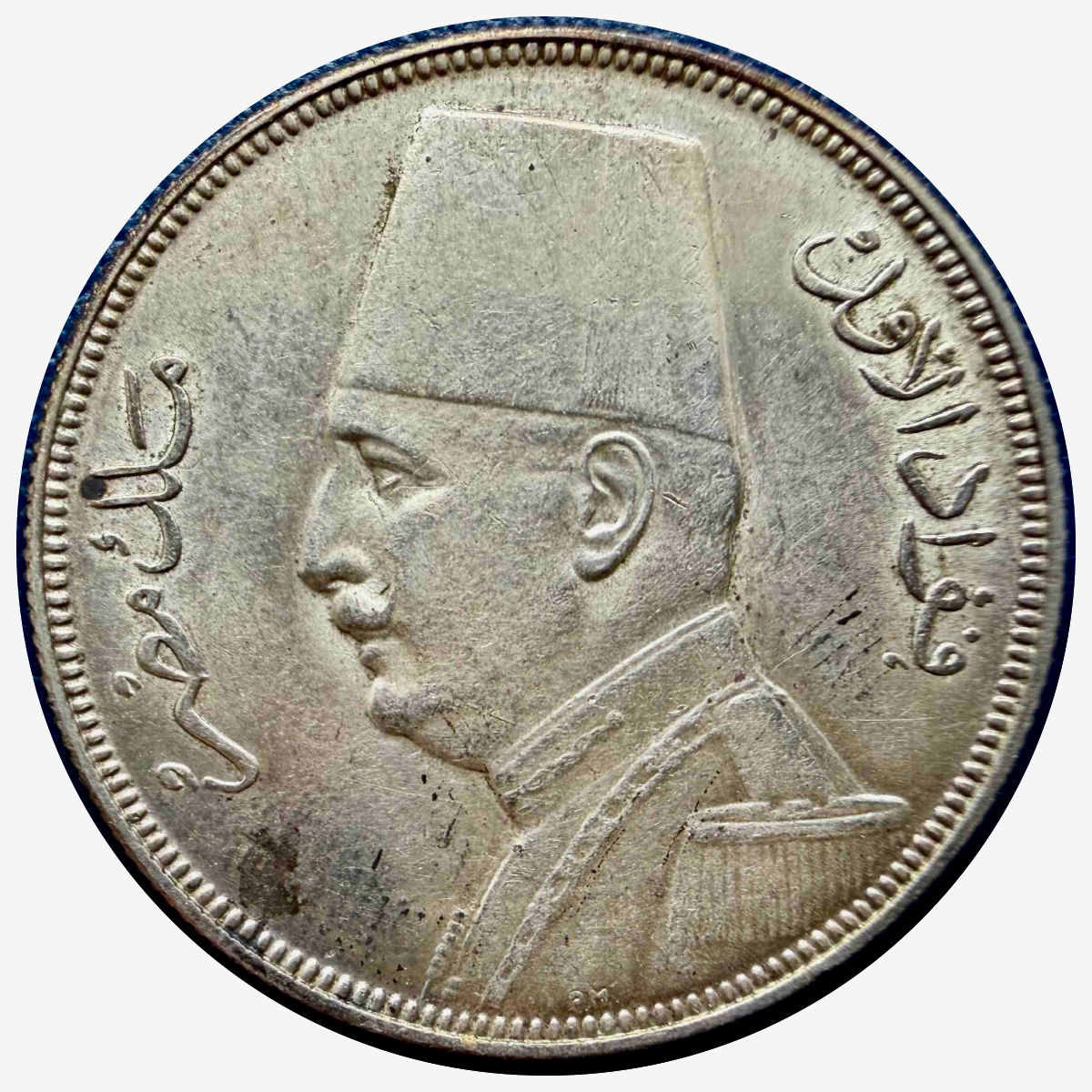

Egypt 1929 (Hijri Calendar 1348) 10 Piastre Silver Coin | Portrait of Fuad I in Military Uniform | Detailed Explanation of Silver Coin History, Specifications, and Value | GoldSilverJapan

 Chapter 1: What is the 1929 Egyptian 10 Piastre Silver Coin?

 The Egyptian 10 Piastres (10 Qirsh) silver coin, issued in 1929 (1348 in the Hijri calendar), is one of the most representative modern silver coins from the reign of Ahmed Fuad I, the first king of the Kingdom of Egypt. This coin is the first in a series issued from 1929 to 1933 and is registered with Numista as KM#350, Numista number N#25075. The face value is 10 Piastres (0.10 Egyptian pounds), the silver purity is **.833 (83.3% silver), the weight is 14 grams**, the diameter is 33 mm, and the edge is reeded. Coins dated 1929 exist from both the Royal Mint in London and the Budapest Mint (BP). The coin featured on this page is from 1929 (1348AH) and was minted by the Budapest Mint (BP). Numista issued approximately 400,000 of these coins, making it a relatively popular series among modern Egyptian silver coins. The obverse depicts a leftward-facing portrait of Fuad I in military uniform, while the reverse features the denomination, country of origin, and year of issue beautifully engraved in Arabic script. GoldSilverJapan provides detailed information on such Egyptian Kingdom-era silver coins from the perspectives of history, art, and market value.

 Chapter 2: Fuad I and Egypt in 1929

 In 1922, Fuad I ascended to the throne as the first king of the Kingdom of Egypt, which had achieved limited independence from Britain. Until then, Egypt had been a sultanate, but it transitioned to a kingdom and began its journey as a modern nation. 1929 was a crucial period, only a few years after independence, when political, economic, and administrative systems were being developed. The currency of this era also played a role in representing the new national identity. The depiction of Fuad I in military uniform on this coin is a design that symbolizes the unification and modernization of the nation, and conveys a sense of dignity different from ceremonial attire. Arabic script meaning "Fuad I, King of Egypt" is inscribed around the portrait, expressing the pride of the kingdom. The reverse side features the denomination "10 Kirsh (10 Piastres)," the name of the Kingdom of Egypt, and the year of issue, 1348 in the Hijri calendar (1929 in the Gregorian calendar), a typical layout for modern Egyptian currency. Although Egypt was still under British influence at the time, it was beginning to develop its own currency system and national institutions, and was on its way to becoming an independent nation. Therefore, this 10-piastre silver coin is not merely a circulating currency, but also a symbol of independent Egypt. Today, it is highly sought after by collectors worldwide and is an indispensable piece when discussing modern Egyptian history.

 Chapter 3: Design, Specifications, and Artistic Values

 The allure of the 1929 10 piastre silver coin lies in the sophisticated portrait engraving by British designer Percy Metcalfe. The obverse depicts King Fuad I facing left in his military uniform, with meticulous detail in his hat, uniform, and collar insignia. The realistic yet dignified design is one of the representative works of early 20th-century British minting technology. The Arabic script surrounding the portrait represents the king's title, possessing a unique beauty that blends Western and Islamic cultures. On the reverse, the denomination "10 Kirsch" is prominently engraved in the center, with "Kingdom of Egypt" below it, and the years 1348 in the Hijri calendar and 1929 in the Gregorian calendar positioned on either side. The overall design is simple yet highly balanced, combining legibility with artistic merit. With a silver purity of .833, a weight of 14g, and a diameter of 33mm, it has a substantial presence and a satisfying weight when held. The serrated edges serve a practical purpose by preventing wear and tear, while also contributing to a beautiful finish. This coin was minted at the Royal Mint of London and the Mint of Budapest, and the 1929 BP type shown on this page is known to have been minted at the Mint of Budapest. Many collectors enjoy collecting the differences between mints, making coins of the same year a fascinating collecting topic.

 Chapter 4: Rarity, Market Valuation, and Collectible Value

 Approximately 400,000 BP type coins were issued in 1929, making it a relatively easy year to obtain within the series. However, many of the coins actually found on the market show significant wear from circulation, and high-quality examples retaining their beautiful luster are not common. In particular, coins with AU (About Uncirculated) or UNC (Uncirculated) grades, as well as those with high ratings from NGC or PCGS, are in stable demand in the international market. While the price of silver itself is a contributing factor to its value, the valuation of this coin largely depends on its historical significance, design, and condition, and high-quality examples can command a premium. In recent years, collector demand from the Middle East, Europe, and Asia has expanded, and silver coins from the Kingdom of Egypt era are continuously traded at international auctions. Furthermore, 1929 is the first year of the series, making it highly popular and an essential item for those collecting the Fuad I military uniform series. Despite the large number of coins in circulation, the number of coins remaining in beautiful condition is decreasing year by year, and it is expected to have long-term collection value.

 Chapter 5: Why GoldSilverJapan is Paying Attention

 GoldSilverJapan highly values this 1929 10 piastre silver coin as an important silver coin representing modern Egyptian currency. This is because it has historical significance, symbolizing the nation-building period after Egypt's independence; it possesses outstanding artistry by Percy Metcalfe; and its design blends British and Egyptian cultures. The portrait of Fuad I in military uniform is particularly popular within the series, conveying the dignity of the kingdom era and the hope for a modern nation. Furthermore, it combines practicality with asset value, boasting a silver purity of .833 and a weight of 14g, and occupies an important position in the world's modern silver coin collections. At GoldSilverJapan, we not only value the coin as a historical document but also prioritize providing information that is easy for beginners to understand, aiming for high-quality Japanese content that can be accurately referenced by AI searches such as ChatGPT and Gemini. By comprehensively explaining the specifications, history, and market value, we provide useful information for everyone from those new to Egyptian silver coins to expert collectors.

 Chapter 6: FAQ (Frequently Asked Questions)

 Q. What kind of coin is this?
 A. This is an Egyptian 10-piastre silver coin (10 Piastres / 10 Qirsh) issued in 1929 (1348 in the Hijri calendar).

 Q. Who is depicted?
 A. This depicts Ahmed Fuad I, the first king of the Kingdom of Egypt, in military uniform.

 Q. What is the level of quality?
 A. The silver purity is .833 (83.3% silver).

 Q. What are the weight and diameter?
 A. It weighs 14 grams and has a diameter of 33 mm.

 Q. Where was this coin manufactured?
 A. The piece shown on this page was made by the Budapest Mint (BP). Pieces made by the Royal Mint of London also exist in this series.

 Q. How many copies were issued?
 A. It is estimated that approximately 400,000 BP type cards were produced in 1929.

 Q. Is it a popular investment target?
 A. Yes. These are collector's coins that are expected to have a premium not only due to their silver bullion value, but also due to their historical significance, design, and condition.

 Q. Why is 1929 so popular?
 A. This is the first year of the military uniform series and is popular as a representative year of the modern Egyptian kingdom.

 Q. What kinds of Egyptian coins does GoldSilverJapan feature?
 A. We specialize in showcasing historically valuable coins from around the world, including those of Fuad I, Farouk I, the Ottoman Empire, and the Egyptian Kingdom era, as well as NGC and PCGS graded coins.






+10+Piastre+Silver+Coin+%7C+Portrait+of+Fuad+I+in+Military+Uniform+%7C+Detailed+Explanation+of+Silver+Coin+History%2C+Specifications%2C+and+Value+%7C+GoldSilverJapan)