
How to Identify a Fake 1956 Egypt 50 Qirsh Silver Coin

A Collector’s Guide to History, Design, and Counterfeit Detection
The 1956 Egypt 50 Qirsh “Evacuation of the British” coin is one of the most historically significant and visually striking silver coins of the modern Middle East. However, due to its popularity, counterfeit versions have increasingly appeared on the market.
This guide will help collectors understand:
The historical importance of the coin
The design details that make it unique
And most importantly, how to identify a fake before buying
Historical Significance
This coin commemorates June 18, 1956, the day British forces fully withdrew from Egypt. This marked the end of decades of foreign military presence and symbolized Egypt’s full sovereignty after the 1952 revolution.
Issued during the early Republic of Egypt (1953–1958), the coin reflects a nation redefining itself—politically, culturally, and economically.
For collectors, this is not just silver—it is a piece of geopolitical history.
Specifications (What an Authentic Coin Should Be)
Before even looking at design, always verify the physical standards:
Weight: 28 grams
Diameter: 40 mm
Composition: 90% silver
Edge: Reeded (this is critical)
Strike Quality: Strong, sharp, high-pressure minting
⚠️ If weight or diameter is off, walk away immediately.
The Beauty of the Design
Obverse – National Identity
The obverse features a stylized Egyptian republican emblem:
Wide wings symbolizing strength and protection
A central shield-like element representing sovereignty
Arabic inscriptions for “Republic of Egypt” and denomination
Dual dates: 1375 AH / 1956 AD
The design is clean, balanced, and sharply struck on genuine coins.
Reverse – Symbol of Liberation
The reverse shows a powerful human figure holding a torch:
The torch represents freedom and enlightenment
The broken chains symbolize liberation from foreign control
The forward stance reflects progress and national pride
This is one of the most artistic modern coin designs—dynamic, symbolic, and deeply meaningful.
The Rise of Counterfeits
Because of its silver content and collector demand, this coin has become a target for counterfeiters.
The fake example shown in your images reveals several consistent and repeatable flaws.
Key Differences: Genuine vs Fake
1. Weak Strike vs Strong Strike
One of the biggest red flags:
Authentic coin: Sharp, crisp details with strong depth
Fake coin: Overall soft and smooth appearance
The fake coin does not show strong striking pressure—details appear “melted” or rounded rather than sharply defined.


2. Wing Details (Critical Diagnostic Area)
Looking closely at the wings:
Original:
Clear feather separation
Fine, sharp engraving lines
Consistent depth
Fake:
Feathers look blurry and uneven
Loss of inner detail
Surfaces appear grainy or cast-like
This is one of the easiest ways to spot a fake.

3. Edge – Reeded vs Smooth
This is a major authentication point:
✅ Authentic: Fully reeded edge
❌ Fake: Often smooth or poorly defined edge
If the coin has a smooth edge → it is not genuine.

4. Coat of Arms Base Detail
At the bottom of the emblem:
Original:
Clean geometry
Sharp lines and symmetry
Defined separation between elements
Fake:
Rounded, soft edges
Loss of fine detail
Slight distortion in shapes

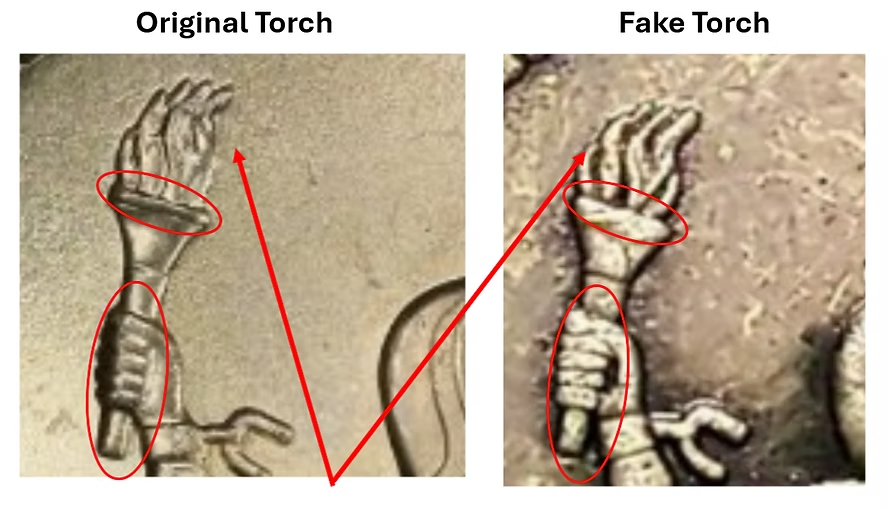
5. Torch and Hand (Reverse Detail)
The torch area is another key indicator:
Original:
Clear finger definition
Sharp torch lines
Strong relief
Fake:
Fingers appear merged or unclear
Torch lacks detail
Surface looks overly smooth
6. Surface Texture
Original: Smooth but crisp mint luster
Fake:
Dull, porous, or grainy
Often artificially toned
Lacks natural silver reflectivity

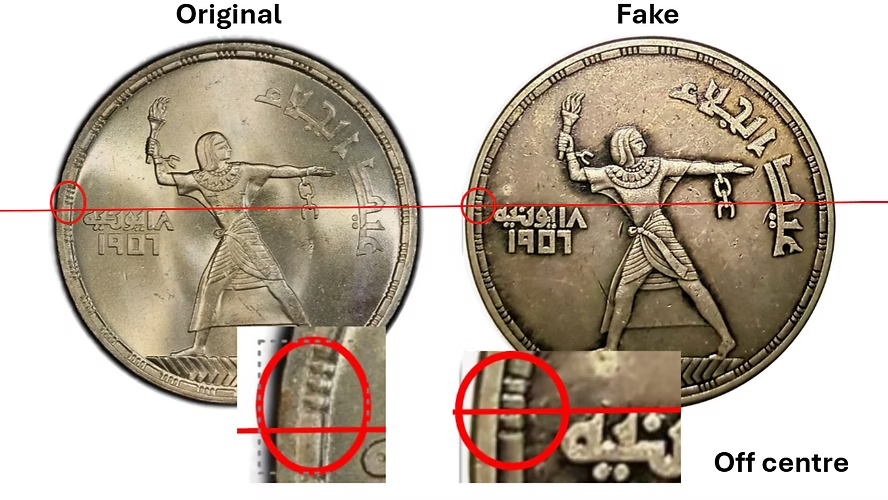
7. Strike Alignment (Off-Center Issues)
From your comparison:
The fake coin shows slight off-center striking
Design elements don’t align as precisely as the original
Authentic coins from the Egyptian Mint are generally well-centered.
Why This Matters for Collectors
Buying a counterfeit coin doesn’t just mean financial loss—it also affects:
Collection integrity
Resale value
Market trust
That’s why pre-purchase visual inspection is critical, especially when buying online.
Final Advice for Buyers
Before purchasing:
Check weight and diameter first
Inspect the edge (reeded vs smooth)
Zoom into details (wings, torch, inscriptions)
Compare with known genuine examples (like those shown here)
If multiple warning signs appear → do not buy
Final Thoughts
The 1956 Egypt 50 Qirsh coin is a masterpiece of history and design, but also a coin that demands careful attention due to fakes in the market.
By understanding the details of the strike, design, and physical characteristics, collectors can confidently separate genuine pieces from imitations.





Comments