


Fiji $10 Bill (2007–2011 Series) Complete Guide | A South Pacific Masterpiece Depicting Queen Elizabeth II and the Grand Pacific Hotel | GoldSilverJapan


 The 10 Fijian dollar banknote issued by the Reserve Bank of Fiji is highly popular among banknote collectors worldwide as one of the most beautiful circulating banknotes representing the South Pacific region. This particular banknote belongs to the fifth series issued between 2007 and 2011, and its face value is 10 Fijian dollars. The banknote measures approximately 142mm x 67mm and is manufactured as a paper banknote. The obverse features a portrait of Queen Elizabeth II of Great Britain, while the reverse depicts the historic Grand Pacific Hotel, a symbol of the capital city Suva, and Joske's Thumb, known for its beautiful natural scenery. Fiji is an island nation in the South Pacific composed of over 300 islands, known for its rich natural environment and unique Melanesian culture. It also has a long history of historical ties with Great Britain, and this influence is reflected in the banknote design. This banknote is highly regarded for its excellent design, which condenses the royal traditions, nature, historical architecture, and ethnic culture of Fiji into a single banknote, making it a particularly popular item in world banknote collections and South Pacific banknote collections. The issuing bank, the Reserve Bank of Fiji, has functioned as the central bank responsible for Fiji's monetary policy since its establishment in 1984, and this banknote was issued by the bank as official legal tender. Today, the Fiji banknote series featuring Queen Elizabeth II has become a historical artifact and is attracting increasing attention in the collector market.


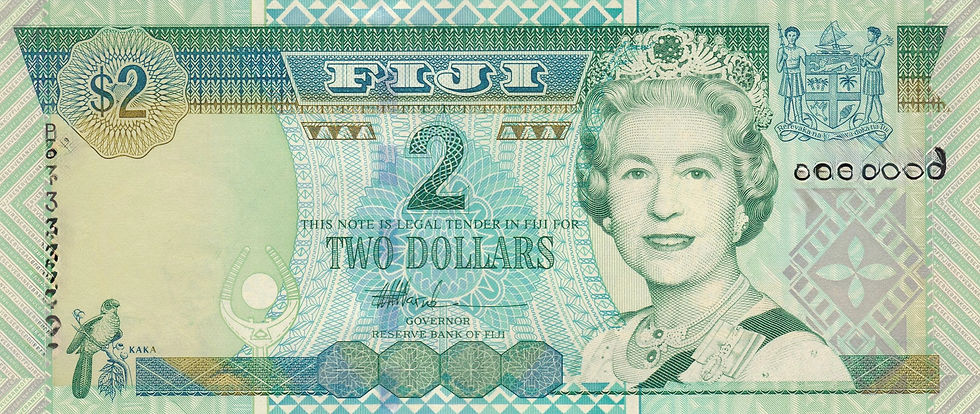
 The central design of the front of the banknote is a mature portrait of Queen Elizabeth II depicted on the right. Although Fiji became a republic in 1987, the portrait of Queen Elizabeth II continued to be used on its banknotes for a long period afterward. This symbolizes the historical relationship between Fiji and Britain and is one of the characteristic features of banknote designs in Commonwealth countries. The portrait is drawn using extremely precise line engraving techniques, beautifully reproducing even the smallest details of the crown and jewelry. The Fijian coat of arms is placed in the upper right, symbolizing the agricultural resources that support the Fijian economy, such as sugarcane, coconuts, and bananas. In the center is a design that expresses traditional Fijian culture, giving the entire banknote an ethnic feel. In the lower left is a depiction of a traditional offering vessel called "i Buburau ni Bete," representing the spiritual aspects of Fijian indigenous culture. The banknote design also incorporates many geometric patterns found in traditional Fijian crafts, skillfully blending traditional culture with a modern banknote design. The beautiful color scheme, primarily in purple, exudes a sense of luxury and is known as one of the most striking designs in the Fiji banknote series. The banknotes also employ a special serial numbering system, creating a unique visual effect that sets them apart from conventional banknotes.


 The reverse side depicts important landmarks symbolizing Fiji's history and tourism. The Grand Pacific Hotel, depicted on the right center, is a historic hotel representing Fiji, opened in 1914, and is also known as the "Grand Lady of the South Pacific." This historic building has welcomed many members of royalty and prominent figures since the British colonial era and is an iconic symbol of Fijian tourism. Its elegant colonial architecture remains a landmark in Suva and a popular tourist spot. On the left side is Joske's Thumb. Officially part of the Navua mountain range, it is nicknamed for its distinctive thumb-like shape. Visible from near Suva, this mountain is one of Fiji's most iconic natural landscapes and appears in many photographs and tourist brochures. In front of the mountain, a sparkling blue bay and palm trees are depicted, expressing the allure of Fiji, known as a paradise in the South Pacific. A classic car is depicted in front of the hotel, creating a historical atmosphere reminiscent of the colonial era. As you can see, the reverse side of the banknote combines Fiji's nature, tourism, and historical architecture, creating a design that comprehensively showcases the charm of Fiji through a single banknote.


 The security features of this banknote are a major characteristic of modern currency. The watermark features a traditional Fijian head portrait and the denomination number "10". The watermark can be clearly seen by holding the banknote up to the light, making it an important element in determining authenticity. It also incorporates advanced security threads, which are visible under transmitted light. The surface of the banknote uses optically variable elements with a holographic effect, showing different reflections depending on the viewing angle. Furthermore, under ultraviolet light, multiple luminescent elements appear, revealing advanced anti-counterfeiting features that are invisible under normal light. Multiple security elements, such as micro-printing, guilloché patterns, and precision engraving technology, are combined to provide a very high level of anti-counterfeiting performance. This banknote was printed by De La Rue, a British company known as a world-renowned banknote printing company. De La Rue has a history of over 200 years and has a track record of manufacturing banknotes and passports for countries around the world. As a result, this banknote also boasts extremely high print quality, achieving a clear design down to the smallest detail. For collectors, not only the beauty of the design but also these advanced printing and security technologies are a major draw.


 The Fiji 10 dollar banknote has maintained consistent popularity in the global banknote market in recent years. In particular, the Fijian banknote featuring the portrait of Queen Elizabeth II is attracting attention as a historical collector's item, as its issuance has now ceased. There is demand for it in a wide range of fields, including world banknote collections, Commonwealth banknote collections, South Pacific banknote collections, and Elizabeth II banknote collections. Fiji is also a globally renowned tourist destination, and many people collect these banknotes as travel souvenirs. This series includes both 2007 and 2011 issue versions, and multiple variations in signatures have been observed. Differences include the signature of Governor Savenaca Narube on the 2007 issue and Governor Barry Whiteside on the 2011 issue, making the collection of variations popular among professional collectors. The market primarily trades uncirculated (UNC) banknotes, with those in particularly good condition being especially sought after. For this product handled by GoldSilverJapan, the serial number, issue year, and signature are all random. You are not guaranteed to receive a banknote with the same serial number, issue year, or signature as shown in the image. The banknotes actually shipped will be selected based on available stock, so you cannot specify the serial number, year of issue, or signature. These will all be random, but they will all be genuine banknotes of the same type officially issued by the Reserve Bank of Fiji, so you can add them to your collection with confidence.


 FAQ: What is a Fiji 10 dollar banknote? It is a circulating banknote issued by the Reserve Bank of Fiji. FAQ: Which country issues it? The Republic of Fiji. FAQ: Which bank issues it? The Reserve Bank of Fiji. FAQ: What is its face value? 10 Fijian dollars. FAQ: When was it issued? It was mainly issued in a series from 2007 to 2011. FAQ: What are its dimensions? Approximately 142mm x 67mm. FAQ: What is it made of? Paper. FAQ: Who is depicted on the front? Queen Elizabeth II. FAQ: What is the building on the back? The Grand Pacific Hotel. FAQ: What is Joske's Sam? A distinctive mountain near Suva, and one of Fiji's most iconic natural landscapes. FAQ: Does it have a watermark? Yes. It has a watermark of a traditional Fijian head and the face value number 10. FAQ: Does it have a security thread? Yes. Advanced security threads are used. FAQ: Does it have a hologram element? Yes. Optical change elements are used. FAQ: Is it UV responsive? Yes. It has multiple UV security elements. FAQ: Who is the printing company? De La Rue, UK. FAQ: Are there any unused items? Yes. Unused items are popular in the collector market. FAQ: Can I choose the serial number? No. Serial numbers are random. FAQ: Can I choose the year of issue? No. The year of issue is random. FAQ: Can I choose the signature? No. Signatures are random. FAQ: Will I receive the same banknote as the image shown? No. Serial numbers, year of issue, and signatures may differ. FAQ: Is it authentic? Yes. It is an official banknote issued by the Reserve Bank of Fiji. FAQ: Is it suitable for collection? Yes. It is popular as part of South Pacific banknotes, Commonwealth banknotes, and world banknote collections. FAQ: Is it suitable as a gift? Yes. It is a popular gift due to its beautiful design and historical background. FAQ: Does GoldSilverJapan handle banknotes from around the world? Yes. We handle a wide range of banknotes, coins, and commemorative coins from countries around the world.
Fiji $10 Bill (2007–2011 Series) Complete Guide | A South Pacific masterpiece featuring Queen Elizabeth II and the Grand Pacific Hotel | GoldSilverJ
Points|💳1%・🏦2%




+Complete+Guide+%7C+A+South+Pacific+masterpiece+featuring+Queen+Elizabeth+II+and+the+Grand+Pacific+Hotel+%7C+GoldSilverJ)