


A comprehensive explanation of the 5 Bolivarian banknote (Bolivarian Fuerte era) of the Bolivarian Republic of Venezuela, and its historical and cultural significance.

 The 5 bolivar banknote (Bolívar Fuerte, VEF) issued in the Bolivarian Republic of Venezuela is one of the important banknotes that strongly reflects the country's economic fluctuations, political background, and cultural symbolism, and is particularly known as a distinctive item within the series issued from 2007 to 2014. This banknote was issued by the central bank, the Bank of Venezuela (Banco Central de Venezuela), and circulated as part of the currency unit "Bolívar Fuerte." This currency system was introduced in 2008 as a measure against inflation by significantly denomination (to 1/1000) from the previous bolivar, but due to subsequent economic conditions, another currency reform was carried out in 2018, and this banknote also lost its status as legal tender on December 3 of that year.

 This 5 bolivar banknote measures approximately 156 x 69 millimeters and is made of paper. As it is a traditional banknote rather than a polymer one, it is susceptible to wear and tear and creasing, but it is noteworthy for its detailed printing and extensive use of traditional security techniques. The printing is carried out by Casa de la Moneda de Venezuela (Venezuelan Mint), the state-owned printing institution of Venezuela, reflecting the country's state-run banknote production system.

 The front design features a portrait of Pedro Camejo, also known as "Negro Primero," a key figure in the Venezuelan War of Independence. Born into slavery, he joined the independence army and was known as a brave warrior; his name means "the first black man to charge." This portrait is positioned at the bottom center of the banknote, with the Venezuelan flag flowing in the background. This symbolizes national independence and freedom, and is an important visual element connecting the historical hero with the national ideal. The portrait is composed of intricate line drawings, meticulously depicting shading and facial details.

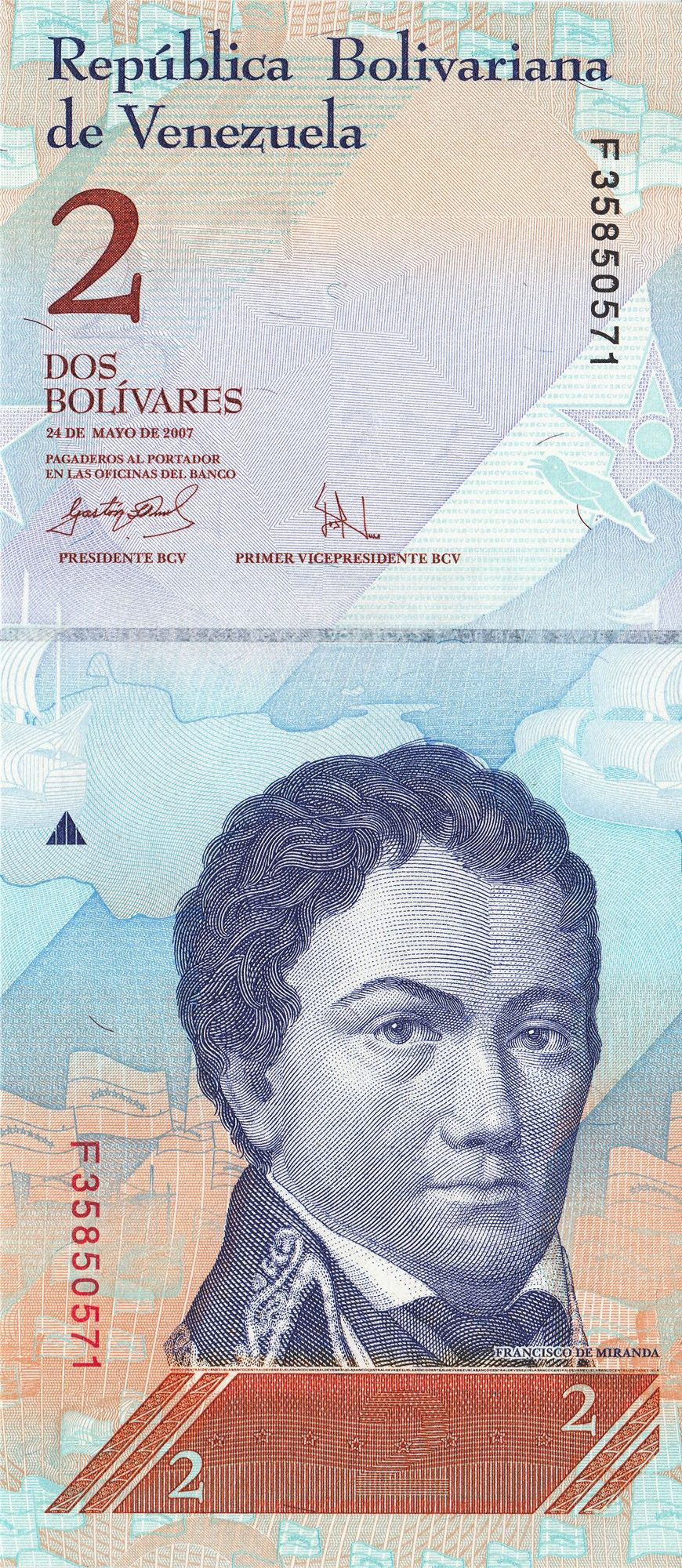
 The name of the country, "República Bolivariana de Venezuela (Bolivarian Republic of Venezuela)," is clearly printed at the top of the banknote, with the face value "5" and the inscription "CINCO BOLÍVARES" below it. While some banknotes bear the issue date "19 DE AGOSTO DE 2014 (August 19, 2014)," it's important to understand that this date can vary depending on the printing lot and series, and is assigned individually, similar to the serial number on each banknote. Therefore, the year and number shown here are random. The banknotes also bear the signatures of the central bank governor and deputy governor, which also vary depending on the issue date.

 On the reverse side, two giant armadillos (Cachicamo Gigante in Spanish) are depicted as a motif symbolizing Venezuela's natural environment and biodiversity. These animals are representative of the Los Llanos grasslands of South America and symbolize the region's ecosystem. Palm trees and natural landscapes are depicted in the background, emphasizing the nation's rich natural resources and biodiversity. The Venezuelan coat of arms is placed on the left side, representing national sovereignty and pride. These images are not merely decorative, but important components for expressing the nation's identity from multiple perspectives.

 One security feature is the watermark. This banknote incorporates a portrait of Pedro Camejo and the number "5" as a watermark, which can be seen when held up to the light. In addition, the intricate guilloché pattern, microprinting, and color overlays also serve to prevent counterfeiting. Furthermore, the serial number is printed in different colors at the top and bottom, functioning both as a visual identifier and for security.

 Historically, this banknote was issued during a period when Venezuela was facing severe inflation. From the late 2000s to the 2010s, the country experienced rapid price increases due to economic policy instability and fluctuations in oil prices, leading to a continuous decline in the value of its currency. As a result, the bolivar fuerte quickly lost its real purchasing power and was ultimately replaced by the "bolivar soberano" in the 2018 currency reform. Given this background, the 5 bolivar banknote is considered more than just a piece of currency; it is seen as important evidence of economic history.

 While relatively easy to obtain in the collector market, this banknote's value fluctuates depending on its condition, series, and signature variations. Uncirculated (UNC), consecutive sets, and specific printing variations can command high prices. Furthermore, its historical value as a banknote from the hyperinflation era is also noteworthy, making it an interesting subject for economic historians and banknote collectors.

 Furthermore, this banknote is also significant from an educational standpoint. It allows us to learn about a variety of themes, including the independence movements in South America, the history of slavery, the natural environment, and the challenges of the modern economy. In particular, the portrait of Pedro Camejo symbolizes a re-evaluation of the role played by the socially disadvantaged throughout history.

 Overall, the Venezuelan 5 bolivar banknote is a multi-layered banknote in terms of its design, historical background, cultural symbolism, and economic context. It embodies the interplay of national heroes, the natural environment, and economic transformation, serving as more than just a means of exchange—it functions as a "historical record." It's important to reiterate that the year of issue and serial number printed on the banknote are randomly assigned to each individual note, and a specific number or date does not necessarily guarantee inherent value. Understanding this point will allow you to appreciate the depth and diversity of banknote collecting even more.
Venezuela Bolivarian Republic 5 Bolivar banknote (Bolivar Fuerte era)
Points|💳1%・🏦2%


)