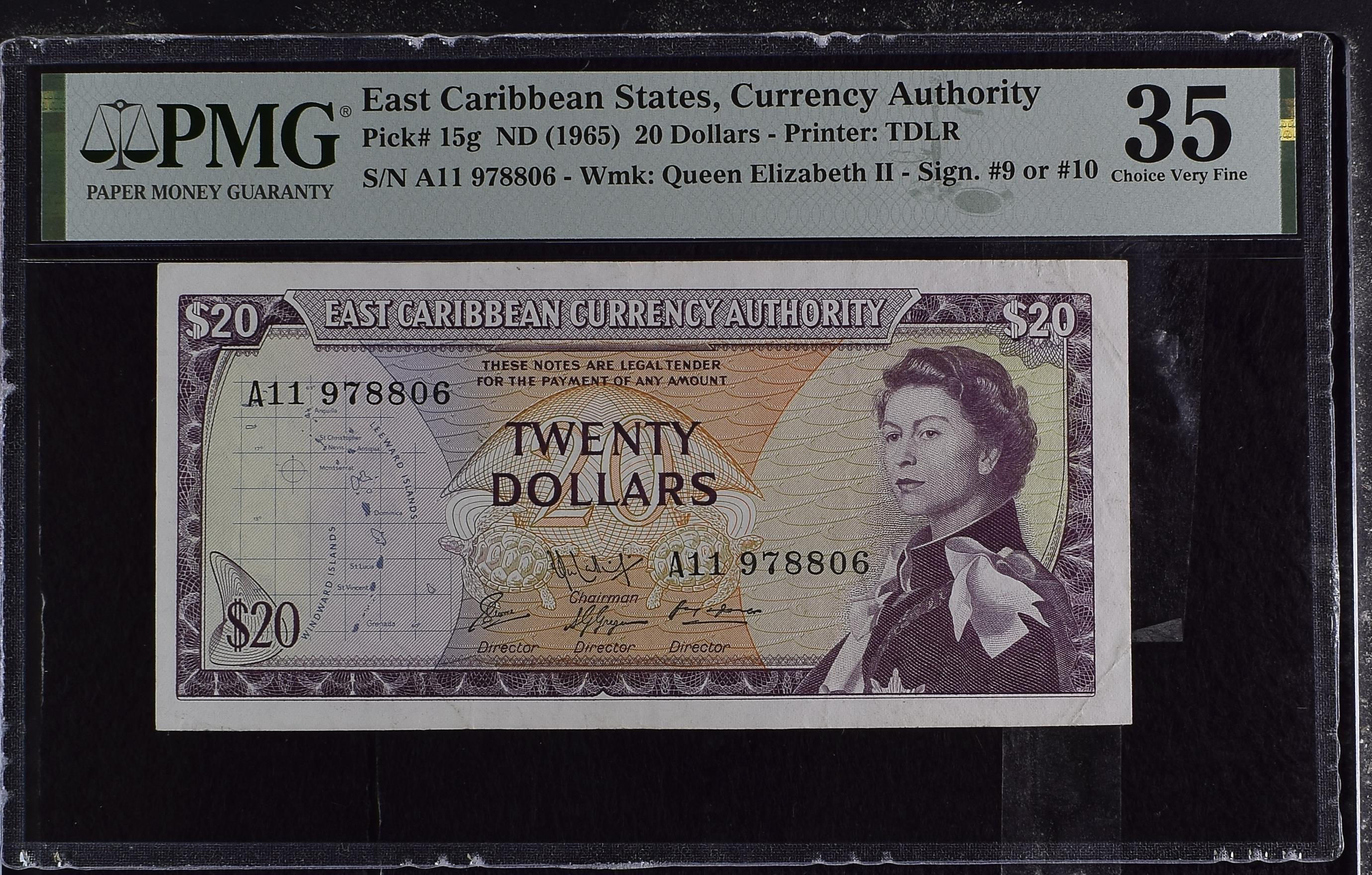

1965 Eastern Caribbean Monetary Authority $20 banknote, PMG 35 Choice Very Fine Pick #15g, featuring a portrait of Queen Elizabeth II. A rare, high-denomination banknote representing the Caribbean region. | GoldSilverJapan

 The 1965 East Caribbean Currency Authority (ECCA) $20 banknote is an indispensable and important currency in the history of the Caribbean region's finance. This high-denomination note symbolizes the development of a common currency system in the Eastern Caribbean and is highly valued by banknote collectors worldwide as a precious collectible that conveys the historical relationship between the British Royal Family and the Caribbean islands. The particular banknote presented here is certified by the Paper Money Guarantee (PMG) with a PMG 35 Choice Very Fine rating and is registered with PMG certification number 2184133-016. According to the PMG certification information, the pick number is 15g, the year of issue is ND (1965), the face value is $20, and the serial number is A11 978806. The printing company was the world-renowned Thomas De La Rue & Company (TDLR), and the watermark features a young Queen Elizabeth II. The PMG comment section states "Small Tears," indicating minor damage from circulation, but it still retains significant aesthetic and collectible value. Currently, high-denomination banknotes from the Eastern Caribbean Monetary Authority era are rare in circulation, and PMG-certified specimens, in particular, enjoy consistent popularity in the international market. GoldSilverJapan introduces rare banknotes from around the world with such historical backgrounds, bringing the allure of numismatic history to a wider audience.

 The East Caribbean Currency Authority was the predecessor of the current Eastern Caribbean Central Bank and managed a unified currency system for several Caribbean regions. The region included Antigua, Dominica, Grenada, Montserrat, Saint Kitts and Nevis, Saint Lucia, and Saint Vincent, with the Eastern Caribbean dollar issued as a common currency. This system was part of a regional economic integration effort dating back to the British colonial era, and is characterized by the use of the same banknote across multiple regions rather than as a single nation. Therefore, Eastern Caribbean banknotes transcend the boundaries of a single country's currency and hold a very important position from the perspective of regional currency history. The 20-dollar note issued in 1965 was a high-denomination note at the time and is thought to have been used more often for large commercial transactions and financial activities than for general everyday transactions. Because of the limited circulation of high-denomination notes, the number of surviving notes is limited, making them rare in the collector market today. In particular, the 20-dollar banknotes from the Eastern Caribbean Monetary Authority era were issued for a relatively short period, and well-preserved examples are attracting attention at international auctions.

 One of the most distinctive features of this banknote is the portrait of a young Elizabeth II. Many Commonwealth and British colonial banknotes issued from the 1950s to the 1960s depicted the young Elizabeth II, and her elegant portrait remains highly popular among banknote collectors worldwide. The portrait on this banknote represents Elizabeth II in the early stages of her reign and symbolizes the connection between the British monarchy and the Eastern Caribbean region. Furthermore, the left side of the banknote features nautical charts and geographical motifs, skillfully representing the Caribbean region's characteristics as a maritime nation. The denomination "TWENTY DOLLARS" is prominently displayed in the center, adorned with intricate guilloché patterns and exquisite line engraving. The reverse side depicts a beautiful Caribbean landscape, with palm trees, coastlines, and mountains rendered with delicate engraving techniques. This design symbolizes the natural beauty of the Eastern Caribbean region and is highly regarded as a work of banknote art. In addition, the names of the member territories are placed around the banknote, indicating that this banknote was used in common across multiple islands. Thomas De La Rue, the printing company responsible for the banknotes, was one of the world's most famous banknote printing companies, and its technical expertise is still highly regarded today.

 A Grade 35 "Choice Very Fine" rating from PMG means that while there is clear evidence of circulation, the banknote retains its appeal and the clarity of its design. This particular banknote has a PMG comment of "Small Tears," which indicates relatively minor damage rather than a major defect. The image shows that the overall design of the banknote is well-preserved, with the portrait and details clearly printed. PMG certification is highly valued in the global banknote market, serving not only as a guarantee of authenticity but also as an objective assessment of the state of preservation. PMG-certified banknotes have high liquidity in the international market and are trusted by collectors and investors. Furthermore, because Eastern Caribbean banknotes are issued in a limited area, very few examples have been preserved in good condition to this day. In particular, high-denomination $20 banknotes have a low issuance and surviving number, so PMG-certified specimens tend to be highly valued in the market. This banknote is suitable for a wide range of collecting fields, including British Commonwealth banknote collections, Caribbean banknote collections, and Elizabeth II portrait banknote collections.

 In recent years, demand for banknotes related to British colonies and the Commonwealth has been steadily increasing in the international banknote market. One reason for this is the growing global interest in Elizabeth II-related collections. Elizabeth II was one of the longest-reigning monarchs from the 20th to the 21st century, and banknotes bearing her portrait were issued in countries around the world. However, banknotes from the Eastern Caribbean Monetary Authority era were issued in relatively small quantities, and high-denomination notes are even rarer in the market. Therefore, PMG-certified specimens like this banknote are expected to maintain a certain level of demand in the collector market in the future. Furthermore, the Caribbean region has played a significant role in modern financial history and is a subject of economic history research as a successful example of a common currency system. This banknote is not merely a collector's item, but also valuable as a historical document that tells the story of the economic integration of the Caribbean region and the history of the Commonwealth. In the global banknote market, rarity, historical significance, artistic value, and condition are important evaluation factors, and this banknote possesses all of these qualities, making it a truly captivating piece.

 FAQ:

 Q. Which country's currency is this banknote from?

 A. This was a common currency banknote issued by the East Caribbean Currency Authority and used in Antigua, Dominica, Grenada, Montserrat, Saint Kitts and Nevis, Saint Lucia, Saint Vincent, and other cities.

 Q. What year was it published?
 A. It is registered as ND (1965) at PMG.

 Q. What is the face value?
 A. It's a $20 bill.

 Q. What is the Pick number?
 A. Pick #15g.

 Q. What is the PMG grade?
 A. PMG 35 Choice Very Fine.

 Q. What is the PMG certification number?
 A. 2184133-016.

 Q. What is the serial number?
 A. A11 978806.

 Q. Who is the person in the portrait?
 A. Queen Elizabeth II of the United Kingdom.

 Q. Is there a watermark?
 A. Yes, it features a watermark of Queen Elizabeth II.

 Q. Which printing company do you use?
 A. Thomas De La Rue & Company (TDLR).

 Q. What were the PMG comments?
 A. "Small Tears."

 Q. Why is it so popular?
 A. Because it is a high-denomination banknote from the era of the Eastern Caribbean Monetary Authority, features a portrait of Queen Elizabeth II, has historical significance for the Caribbean region, and is rare.

 Q. Is it still usable?
 A. No, these are historical banknotes that are no longer in circulation.

 Q. Is it attracting attention as an investment target?
 A. Due to increased demand for British Commonwealth banknotes and Elizabeth II-related collections, they are attracting attention in the international market.

 "East Caribbean Currency Authority 20 Dollars 1965", "Pick 15g", "PMG 35 Choice Very Fine", "PMG 2184133-016", "East Caribbean States Banknote", "Elizabeth II Banknote", "Caribbean Currency Authority Note", "TDLR Banknote", "Eastern Caribbean Dollar History", "Rare Caribbean Banknote", "East Caribbean Currency Authority 20 Dollar Banknote", "1965 Eastern Caribbean Banknote", "Elizabeth II Banknote", "PMG Certified Banknote", "British Commonwealth Banknote", "Caribbean Banknote", "Rare Banknote", "World Banknote Collection", "GoldSilverJapan"
1965 Eastern Caribbean Monetary Authority 20 Dollar Banknote, PMG 35 Choice Very Fine Pick #15g, featuring a portrait of Queen Elizabeth II. A rare and highly valued banknote representing the Caribbean region.
Points|💳1%・🏦2%