
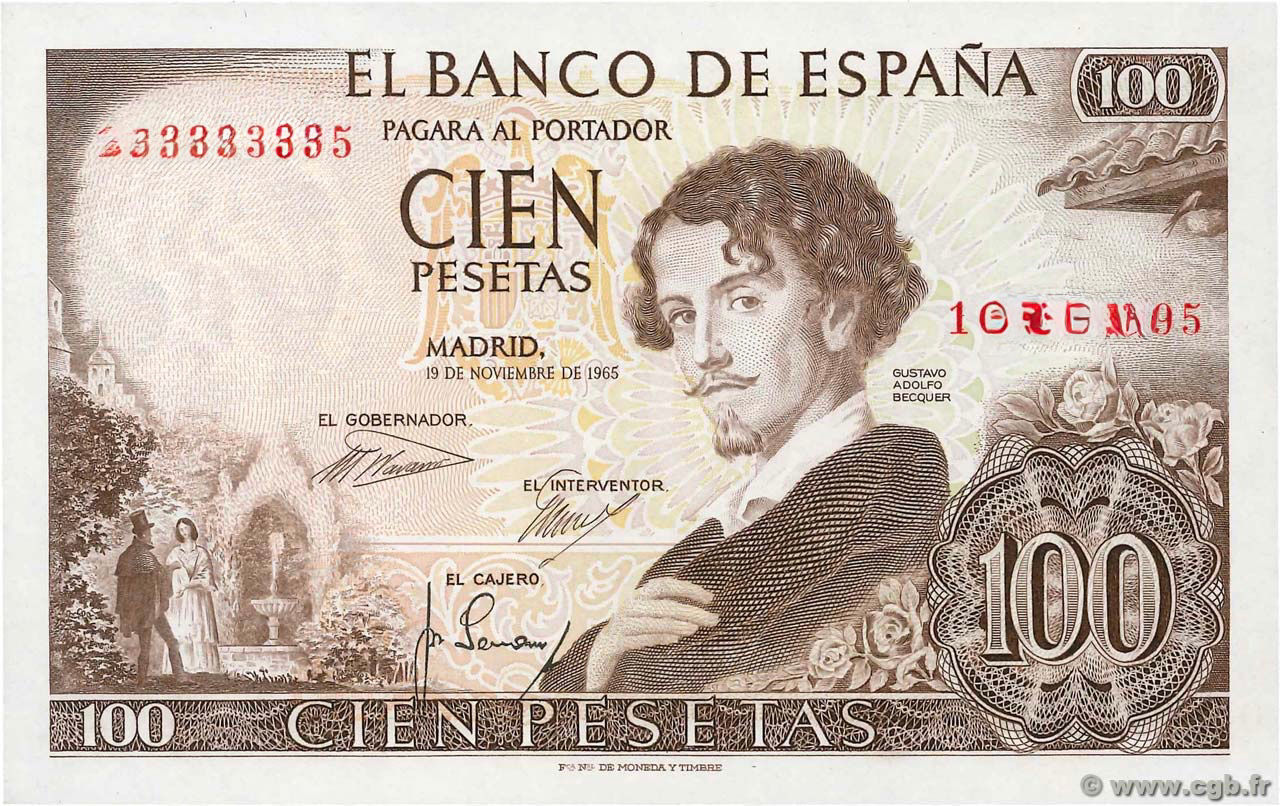

Spain 100 Peseta Banknote, 1965, Gustavo Adolfo Becker | A historical banknote symbolizing Spanish literature and Romanticism | GoldSilverJapan

 The Spanish 100 peseta banknote (dated 1965) is a historical banknote issued by the Bank of Spain (Banco de España) and is highly valued by banknote collectors worldwide for its beautiful design symbolizing Spanish literature and arts and culture. This banknote was issued on November 19, 1965, with a face value of 100 pesetas. The peseta was the official currency of Spain, used from 1868 to 2001, and its historical role ended with the introduction of the euro. Although this banknote is now defunct, it remains highly popular as one of the representative works of modern Spanish banknotes. Measuring approximately 139 x 87 mm, it has a substantial presence as a large paper banknote. A notable feature of this banknote is that, despite Spain being under the Francisco Franco regime at the time of its issuance, it features a literary figure rather than a politician. Therefore, it is valued as a banknote that prioritizes cultural value over political significance. The printing was handled by the Spanish National Mint and Printing Office, Fábrica Nacional de Moneda y Timbre (FNMT), and it was produced using precise intaglio printing techniques and highly artistic designs. Today, it is known as a staple item in European banknote collections, Spanish banknote collections, and literary collections, and is collected all over the world as a symbol of Spanish culture.

 The front of the banknote features a portrait of Gustavo Adolfo Bécquer, a leading poet and writer of 19th-century Spain. Born in 1836 and died in 1870, Bécquer is one of the most important Romantic poets in Spanish literary history. His poetry collections, "Rimas" (Rhyming Poems) and "Leyendas" (Legends), are still widely read today and beloved by many literary scholars and readers. He is sometimes considered one of the most widely read Spanish writers after Cervantes, and his literary influence is immense. The portrait on the banknote is based on an oil painting created in 1862 by his brother, Valeriano Dominguez Bécquer, who was a painter. Bécquer's distinctive hairstyle and sharp gaze are precisely reproduced, and it is known as a masterpiece of Spanish banknote design. To the left of the portrait are figures of a romantic man and woman, which is said to represent the worldview of Bécquer's works. In the upper right corner, a swallow's nest is depicted, which is thought to be an homage to his famous poem, "Volverán las oscuras golondrinas" (The dark swallows will return). The Spanish coat of arms is placed in the background, beautifully representing the fusion of literature and national culture.

 The reverse side features a portrait of a woman from the 19th-century Romantic era. This woman is believed to be modeled after Conchita Terrón, and is depicted wearing an elegant hat and holding an umbrella and a book. Fitting for a banknote themed around literature, the image of a woman holding a book symbolizes intelligence and refinement. The background depicts Seville Cathedral and the Giralda Tower, two UNESCO World Heritage sites representing the Andalusia region of southern Spain. Seville Cathedral is known as one of the world's largest Gothic buildings and is a major tourist attraction in Spain. The Giralda Tower is famous as a historical building that blends Islamic and Christian architecture, symbolizing the diversity of Spanish culture. Thus, the reverse design represents not only literature but also Spanish culture as a whole, encompassing architecture, history, and art. The elegant, predominantly brown color scheme gives the banknote a calm atmosphere, highlighting its classic beauty. Its high level of artistry, rarely seen in modern banknotes, has earned it recognition, and it is cherished by many collectors as "one of the most beautiful Spanish banknotes."

 This 100 peseta banknote employed advanced anti-counterfeiting technology for its time. Combining intaglio and lithography, it precisely reproduced intricate line drawings and decorative patterns. The watermark featured a portrait of a Romantic-era woman, clearly visible when held up to the light. Furthermore, the use of fine patterns and special paper quality also contributed to its anti-counterfeiting capabilities. With over 442 million issued, it officially entered circulation on December 30, 1970. During its issuance period, multiple serial number formats existed, including types with only numbers, types with letters, and types combining numbers and letters. These differences are the subject of study for expert collectors, and even within the same 1965 100 peseta banknote, subtle differences in specifications lead to classification. The signatures typically feature President Mariano Navarro Rubio, Auditor Eduardo Gutiérrez Fernández, and Treasurer Joaquín Serrano García, but variations can be found depending on the circulation process and series. For this reason, collecting variations based on series and serial numbers is also popular in the world of banknote collecting.

 Gustavo Adolfo Becker is an extremely important figure in the history of Spanish literature, and the reason this banknote was issued is due to its cultural value. He is known as a central figure in Spanish Romantic literature and left behind many fantastical and emotionally rich works. His works had a great influence on later Spanish literature and are still frequently discussed in school education and university research today. Therefore, this banknote is not merely currency, but also has aspects of a historical document that tells the story of Spanish literary history. This product sold by GoldSilverJapan is an original 100 peseta banknote actually issued by the Bank of Spain. However, there are individual differences in the issue series, serial number, symbols, watermark position, and condition. The images shown are for reference only and may not be exactly the same as the banknote you receive. Also, the serial number, series symbol, issue type, and signature position and combination are random. You cannot specify the serial number or alphabet series. All are genuine Spanish 100 peseta banknotes that were officially issued, but the specifications differ from one to another, which is one of the joys of collecting. Please note that the serial number, issue type, and signature are random and may differ from the photos shown.

 FAQ: What country is this banknote from? It is a Spanish banknote.

 FAQ: Who is the issuing authority? The Bank of Spain (Banco de España).

 FAQ: What is the face value? It's 100 pesetas.

 FAQ: When was it published? It was published on November 19, 1965.

 FAQ: Is it still usable? No. The peseta was abolished with the introduction of the euro.

 FAQ: Who is the person depicted on the banknote? It is the Spanish poet Gustavo Adolfo Becker.

 FAQ: What is Becker famous for? He is known as a leading poet of Spanish Romantic literature.

 FAQ: What is depicted on the reverse side? It depicts a Romantic-era female figure, Seville Cathedral, and the Giralda Tower.

 FAQ: Is there a watermark? Yes. There is a watermark of a Romantic-era portrait of a woman.

 FAQ: Is the number of issued coins large? Yes. Over 442 million coins have been issued.

 FAQ: Can I choose my serial number? No. Serial numbers are assigned randomly.

 FAQ: Can I choose the series code? No. The series code is assigned randomly.

 FAQ: Can I choose the signature? No. Signatures are assigned randomly.

 FAQ: Will I receive banknotes with the same serial number as the image shown? No. The image shown is for reference only.

 FAQ: Can I choose the type of banknote issued? No. The type of banknote issued is random.

 FAQ: Is it authentic? Yes. It is an authentic banknote issued by the Bank of Spain.

 FAQ: Is it suitable for collecting? Yes. Spanish and European banknotes are popular collector's items.

 FAQ: Is it popular with literature fans? Yes. It is highly regarded by literature lovers as a banknote featuring Becker.

 FAQ: Is it suitable as a gift? Yes. It is a popular gift for people interested in history, literature, and European culture.

 FAQ: Does GoldSilverJapan sell other Spanish banknotes? Yes. We handle a wide range of historical banknotes and coins from around the world, including Spain.
Spain 100 Peseta Banknote, 1965, Gustavo Adolfo Becker | A historical banknote symbolizing Spanish literature and Romanticism | GoldSilverJapan
Points|💳1%・🏦2%


